
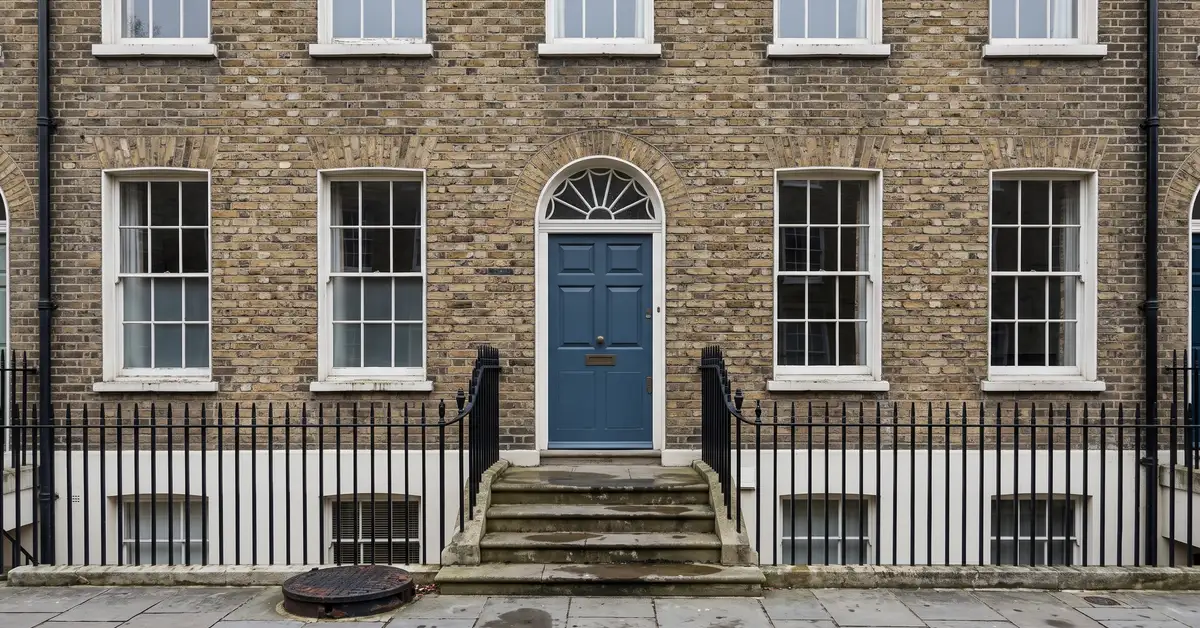
Renovating a listed building in London needs listed building consent for any work affecting its special architectural or historic interest, inside as well as out. There is no application fee and the statutory determination period is eight weeks. London and Kent Construction works on listed and unlisted period houses across London.
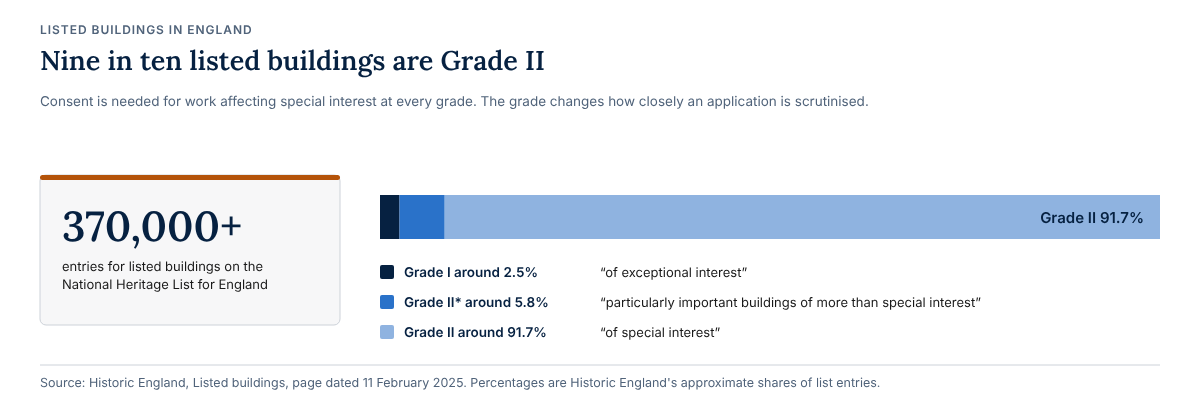
Listing is more common than most buyers expect. Historic England, on a page dated 11 February 2025, states that "There are over 370,000 entries for listed buildings on the National Heritage List for England", and that around 91.7 per cent of them are Grade II, which it calls "the most likely grade of listing for a homeowner". A note on what follows: this is general information about how the consent regime works, not legal advice. On your own building you should take advice from your local authority's conservation officer or a heritage professional.
Listing covers the whole building, including the inside
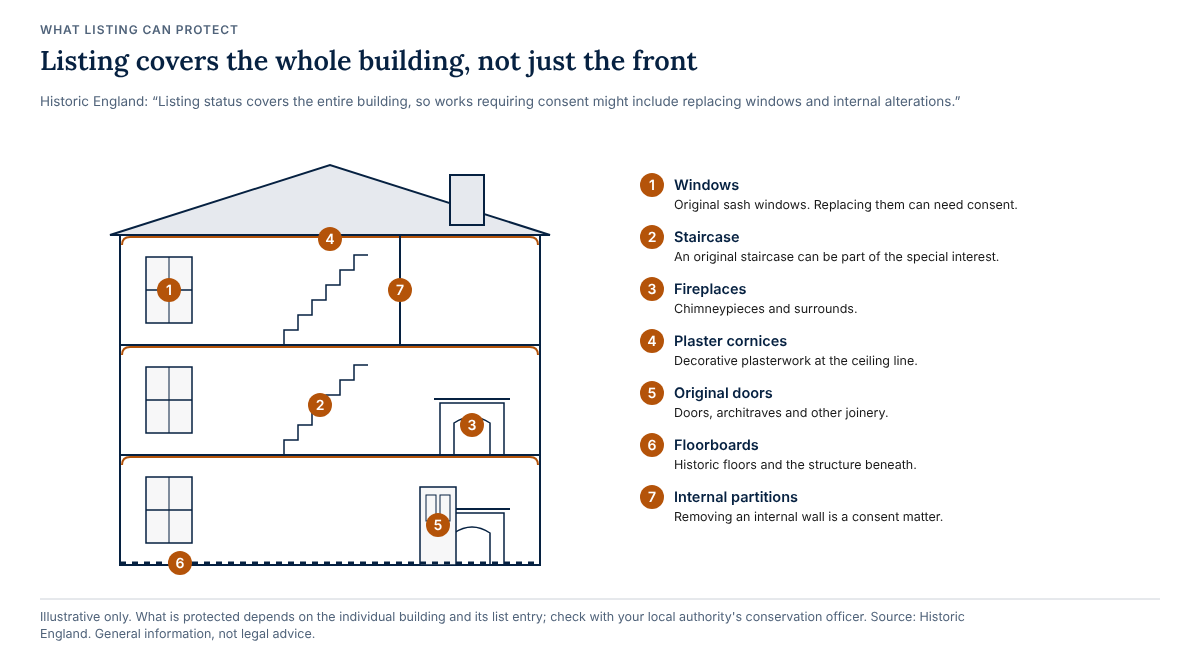
The most expensive misunderstanding about listed buildings is that listing protects the front elevation. It does not. Historic England puts it plainly: "Listing status covers the entire building, so works requiring consent might include replacing windows and internal alterations, for example." That means a staircase, a fireplace, plaster cornices, original doors, floorboards and internal partitions can all be protected and removing an internal wall in a listed house is a consent matter rather than a design decision. The statutory test is in section 7 of the Planning (Listed Buildings and Conservation Areas) Act 1990, which provides that no works may be executed "for the demolition of a listed building or for its alteration or extension in any manner which would affect its character as a building of special architectural or historic interest, unless the works are authorised". Note what that turns on: whether the work affects the character of the building, not whether anyone can see it from the street.
The three grades and what they mean in practice
England has three grades of listing and Historic England describes them as follows: Grade I buildings are "of exceptional interest", Grade II* buildings are "particularly important buildings of more than special interest", and Grade II buildings are "of special interest". It gives the proportions as around 2.5 per cent Grade I, around 5.8 per cent Grade II* and around 91.7 per cent Grade II. The grade does not change whether you need consent, because consent is required for any work affecting the building's special interest at every grade. What it changes in practice is how much scrutiny an application attracts and how little latitude there is on the parts that carry the interest. A Grade II terraced house in Greenwich and a Grade I building are governed by the same section of the same Act.
Listed building consent: no fee, eight weeks and separate from planning
Listed building consent is its own application, distinct from planning permission. It is free. Historic England, on a page dated 21 June 2021, states that if you want to alter or extend a listed building in a way that affects its character "you must first apply for Listed Building Consent from your local planning authority", and that "There is no fee." The statutory determination period is eight weeks: the Planning (Listed Buildings and Conservation Areas) Regulations 1990 require the authority to give notice of its decision within "a period of 8 weeks" from the date the application and certificate were lodged, "or such other period as may at any time be agreed upon in writing". In practice a listed building project often needs both listed building consent and planning permission and the free one is not the quick one: the work that goes into a supporting heritage statement, drawings and schedules of the existing fabric is where the real cost sits.
Unauthorised work to a listed building is a criminal offence
This is the part that makes listed buildings different from every other kind of renovation. Carrying out work in contravention of section 7 is a criminal offence under section 9 of the same Act. The current wording of section 9(4) provides that a person guilty of an offence is liable "on summary conviction, to imprisonment for a term not exceeding six months or a fine, or both" and "on conviction on indictment, to imprisonment for a term not exceeding two years or a fine, or both". The words "a fine" were substituted by amendment in March 2015, replacing a previously stated maximum. Liability falls on the person who executes or causes the works to be executed, which is a reason a homeowner should care whether their builder understands the regime and a reason we ask about listing before we quote. Separately, the local authority can require unauthorised work to be undone. It is worth being clear about the practical risk: the common case is not a prosecution, it is an owner who replaced windows or stripped out original joinery in good faith and then has to put it back at their own cost, often at the point of sale.
A conservation area is not the same as a listing
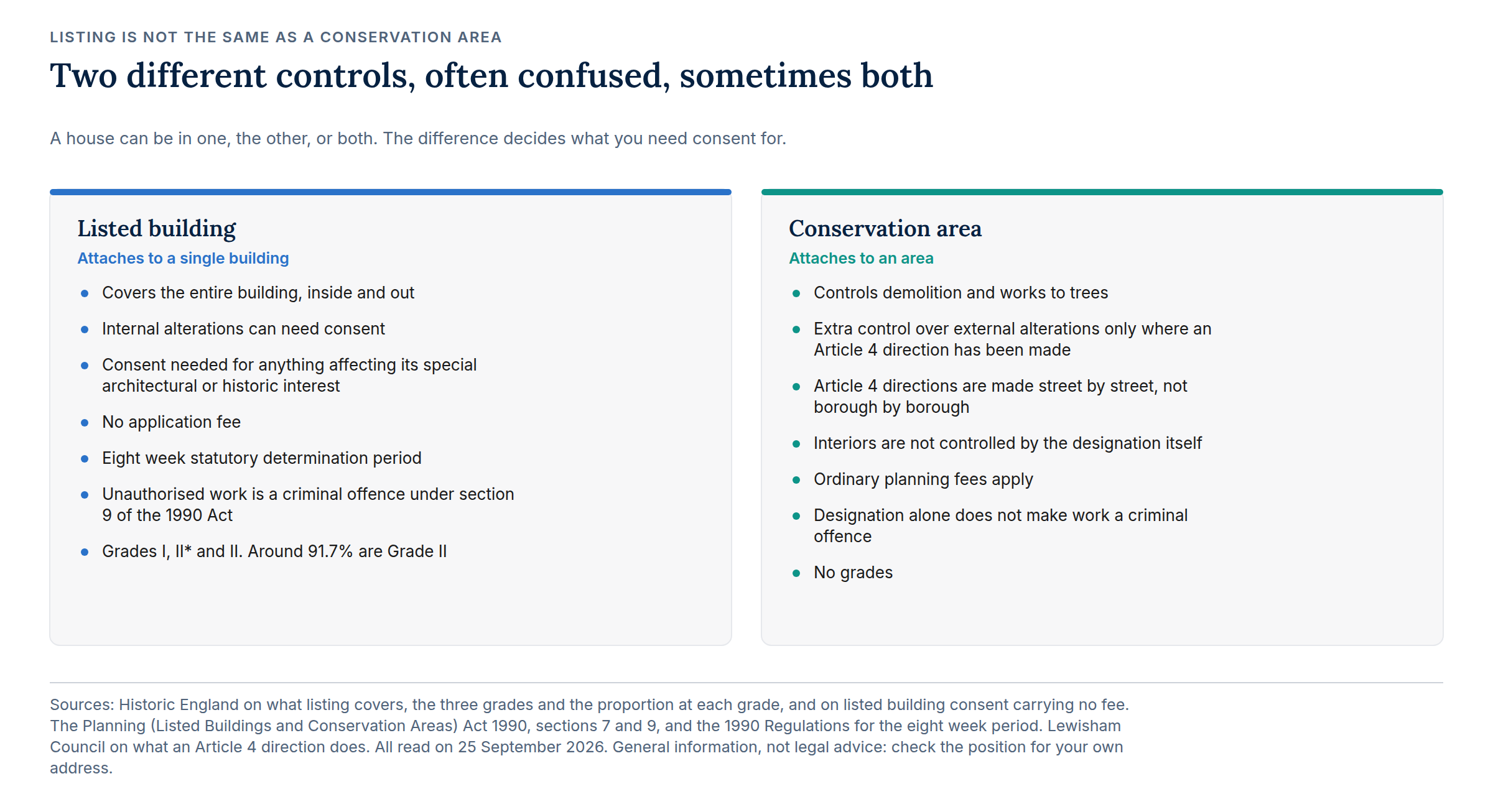
Conservation area status and listing are different things and are often confused. A conservation area is an area designation which brings additional control over demolition, trees and, where an Article 4 direction has been made, over external alterations that would otherwise be permitted development. Listing attaches to a single building and reaches inside it. A house can be in a conservation area and not listed, listed and not in a conservation area, or both. The practical difference is that in a conservation area the argument is usually about what the street sees, while in a listed building the argument includes what only you will see. In west London, the Royal Borough of Kensington and Chelsea's published basements policy states that basement development must not involve excavation underneath a listed building, including vaults.
What changes on site when the building is listed
Listing changes the method, not just the paperwork. Repairs are specified like for like, which on a Georgian or early Victorian house usually means lime mortar and lime plaster rather than cement, because cement is harder than the brick around it and pushes damage into the fabric. Original sash windows are repaired and draught proofed rather than replaced and where replacement is unavoidable the joinery profile is matched. Services are routed to avoid cutting historic fabric, which is slower and takes more thought than chasing a cable through a wall. Anything removed is recorded before it goes and kept where it can be reinstated. Openings between rooms are approached as a heritage question first and a structural one second. All of this is ordinary work for a contractor who does it regularly and expensive improvisation for one who does not. It is the reason a listed building schedule of works reads differently from a normal one.
The consents stack up and run in parallel
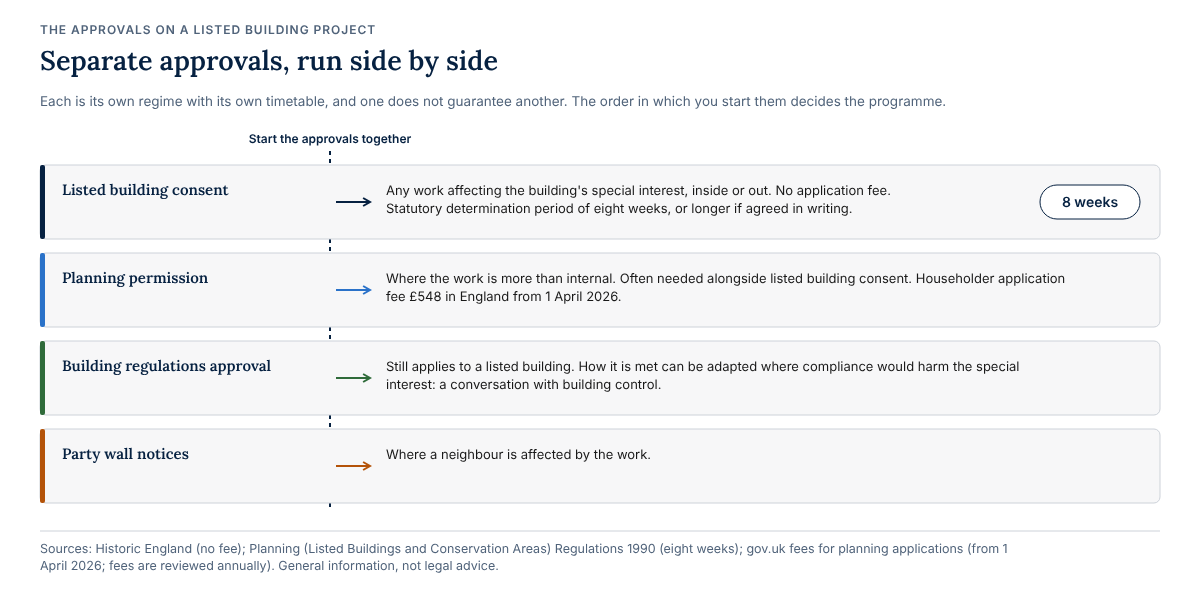
A listed building renovation in London commonly needs several approvals at once: listed building consent, planning permission where the work is more than internal, building regulations approval and party wall notices where a neighbour is affected. They are separate regimes with separate timetables. Nothing about one guarantees another. Building regulations still apply to a listed building, though the way they are satisfied can be adapted where compliance would harm the building's special interest, which is a conversation with building control rather than an exemption to assume. The practical point is that these periods run alongside each other rather than one after another, so the sequence in which you start them decides your programme and the eight week consent period is rarely the longest thing you are waiting for.
How London and Kent Construction works on listed and period buildings
We ask whether the building is listed and which grade, before we price anything. On a first visit we look at what is original and what is later, the condition of the roof, the walls and the windows, where damp is coming from and which of the things you want to change are likely to be the sensitive ones. We then say plainly what we think will need consent and what we would expect an authority to resist, so that the design work is spent on something that can be built. On site we work in the materials the building was built in, record what is removed and keep the conservation officer's conditions in front of us rather than in a drawer. We work on Victorian, Edwardian and Georgian houses across London, including in conservation areas. At the time of writing, in October 2026, we are working on a listed property in west London. We hold CHAS and Constructionline accreditation and are NHBC registered.
Frequently asked questions
Do I need listed building consent for internal work?
Often yes. Historic England states that listing covers the entire building and that works requiring consent "might include replacing windows and internal alterations". The test in section 7 of the 1990 Act is whether the work affects the building's character as one of special architectural or historic interest.
How much does listed building consent cost?
Historic England states plainly that "There is no fee" for a listed building consent application. The cost sits in the supporting work instead: measured drawings, a heritage statement and schedules of the existing fabric and often a separate planning application alongside it.
How long does listed building consent take?
Eight weeks is the statutory period. The 1990 Regulations require the authority to give notice of its decision within eight weeks of the application being lodged, or such other period as is agreed in writing. Pre application discussion with the conservation officer usually happens before that clock starts.
What happens if work is done without consent?
It is a criminal offence under section 9 of the 1990 Act, carrying up to six months' imprisonment and a fine on summary conviction and up to two years on indictment. In practice the common outcome is being required to undo the work at your own cost.
Can I extend a listed house?
Sometimes. It depends on the building rather than the grade. An extension needs listed building consent and usually planning permission too and the argument turns on whether it harms the building's special interest. Start with the conservation officer before commissioning a design.
What to do next
If your house is listed or in a conservation area, the useful next step is to establish what the building will and will not allow before a design is paid for. We will look at the fabric, tell you which of your plans we would expect to be contentious and set out what we would need to price the work. Call 020 8850 7064, email team@londonandkent.co.uk or book a site visit. Our renovation and refurbishment page sets out how we work.