

London and Kent Construction renovates Victorian and Edwardian houses, converted flats and mansion block flats across Battersea, Clapham and Wandsworth. That includes the Shaftesbury Park estate, the Tonsleys, the streets around Battersea Park and the terraces between Clapham Common and Wandsworth Common. Full refurbishment, extensions, loft conversions and structural alterations run under one contract, from the first site visit to handover.
Most of the whole-property projects we carry out cost between £150,000 and £500,000, and some cost more. That sits well above the national figures. Checkatrade, in its cost guide updated in September 2026, puts a three-bedroom house renovation in the UK at £43,530 to £110,350, and a full flat refurbishment at £33,000 to £48,000 in a separate guide updated the same month. Our renovation and refurbishment page sets out what is included and how a project runs.
The housing stock in Battersea, Clapham and Wandsworth
Four kinds of building make up most of the work in this part of south west London. The Victorian terraces on the streets between Clapham Common and Wandsworth Common are wide by London standards, which is why side returns and full width rear extensions are a frequent request, sometimes with basement work underneath. The Shaftesbury Park estate in Battersea is made up of small two storey terraced cottages, inside a conservation area with tight control over elevations and roofs, so loft conversions and rear extensions have to work within that. The Tonsleys and the streets around Old York Road in Wandsworth are compact Victorian terraces on a slope, where ground levels and drainage matter more than elsewhere; in our experience damp there can be caused by a raised external level or a blocked gully rather than anything in the wall. The mansion blocks on Prince of Wales Drive and around Battersea Park are purpose built flats with shared structure and shared services, where the lease and the freeholder decide what is possible before anything is priced. Our own work in the area has included redesigning and refurbishing two flats in Battersea, and a kitchen project in Battersea.

Two councils, and the conservation areas between the commons
Battersea and Wandsworth sit in the London Borough of Wandsworth. Clapham is split between Wandsworth and Lambeth, and both councils have conservation areas around Clapham Common. Wandsworth's own list of conservation area appraisals names Battersea Park, Battersea Square, Clapham Common, Clapham Junction, Latchmere, Park Town, Shaftesbury Park Estate, Wandsworth Common and Wandsworth Town among its areas. Lambeth Council describes its Clapham conservation area as “centred on Clapham Common”, with “many historic buildings dating from the 18th and 19th centuries”, first designated in 1968, alongside separate areas for Clapham High Street, Rectory Grove, Clapham Road, and Clapham Park and Northbourne Road. Wandsworth's conservation area guidance says an Article 4 direction “does not prevent the development in the area to which it has been applied. It instead requires that planning permission is first obtained from the Council.”
Where Article 4 directions apply in Wandsworth
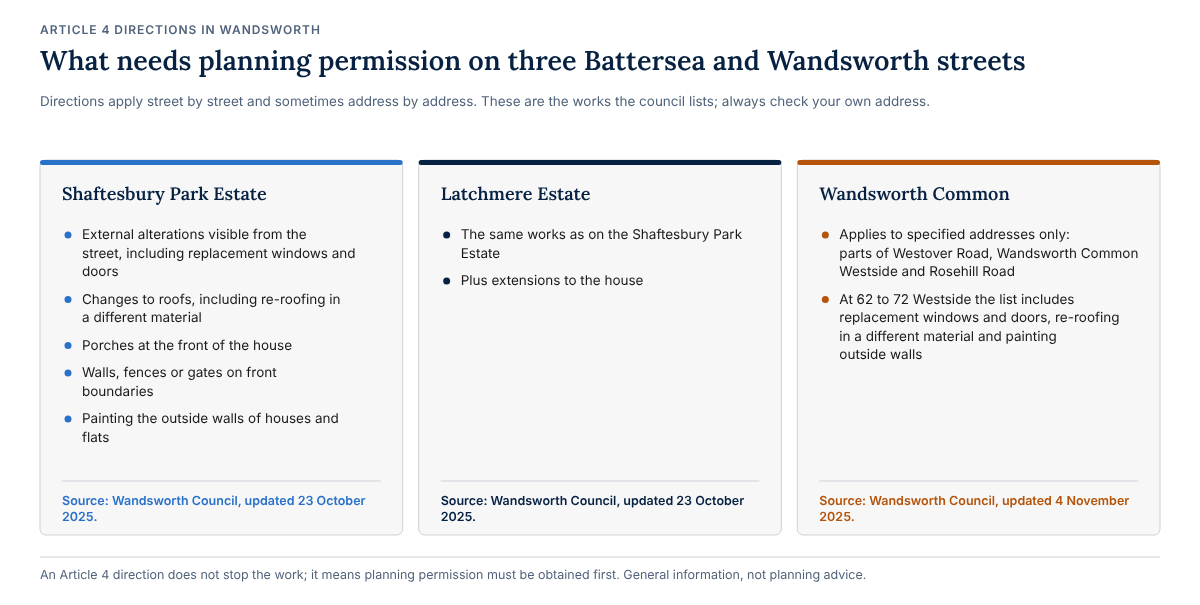
In Wandsworth, the streets with extra planning control are specific and worth checking before any design starts. The council's Article 4 directions page lists the conservation areas where directions apply, including Shaftesbury Park Estate, Latchmere Estate and Wandsworth Common, and warns that “Some directions might only cover parts of the conservation area and might limit specific work.” On the Shaftesbury Park Estate, planning permission is needed for “External alterations to houses which would be visible from the street”, including replacement windows and doors, for “Changes to the roofs of houses; including re-roofing in a different material”, for front porches and for “Painting the outside walls of houses and flats”. The Latchmere Estate direction covers the same works and adds “Extensions to the house”. At Wandsworth Common the directions apply to particular addresses on Westover Road, Wandsworth Common Westside and Rosehill Road, not the whole area. On these streets a like-for-like repair can be fine while a change of material needs an application, so the specification is settled with the consent, not after it.
Converted flats and mansion block flats
A large share of the homes here are flats, and flats work under different rules from houses. The Planning Portal states that “the permitted development rights which apply to many common projects for houses do not apply to flats.” Wandsworth's guidance is more specific for its conservation areas: flats and houses converted to flats “do not benefit from permitted development rights and therefore planning permission will always be needed to change doors and windows.” The lease is the other half of the picture. gov.uk explains that “Your lease will tell you what conditions you've agreed to, for example: if you need permission to make alterations”. In a mansion block that usually means the freeholder or managing agent approves the scope, the working hours and how shared services are touched. We price a flat refurbishment once those terms are known, because they decide what can move.
Basements on the wider plots
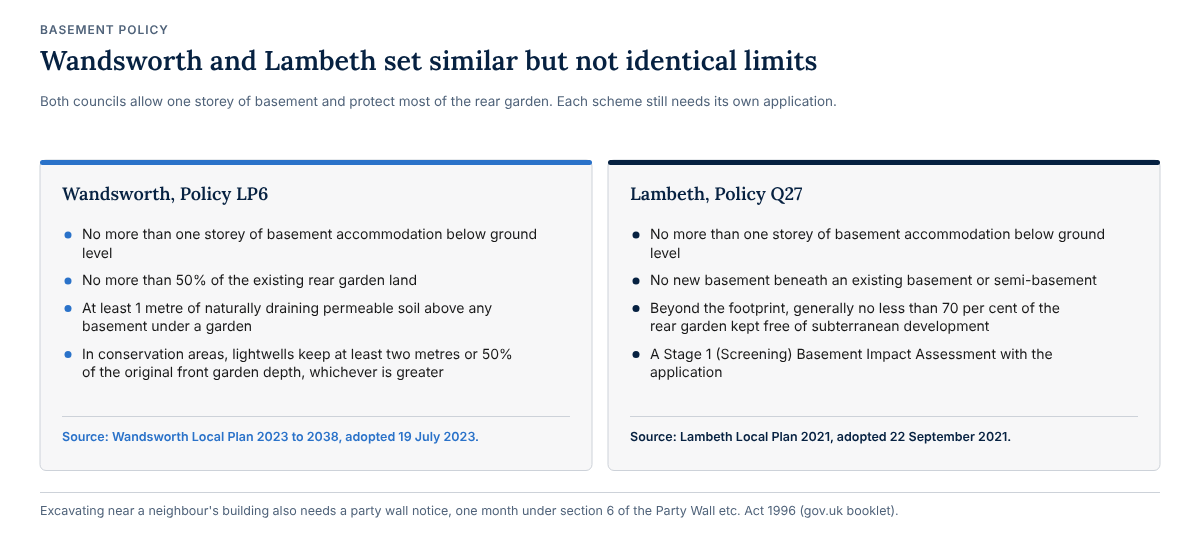
Basement work is more common on the wider plots between the commons, and both councils publish limits. Wandsworth's Local Plan 2023 to 2038, Policy LP6, permits basements only where they result in “no more than one storey of basement accommodation below ground level”, extend to “no more than a maximum of 50% of the existing rear garden land” and keep “a minimum of 1 metre of naturally draining permeable soil above any part of the basement beneath a garden area”. In conservation areas, lightwells must retain “at least two metres or 50% (whichever is the greater) of the original front garden depth”. Lambeth's Local Plan 2021, Policy Q27, also limits basements to one storey, rules out new basements beneath existing basements or semi-basements, generally requires “no less than 70 per cent of the rear garden area” to stay free of subterranean development, and asks for a Stage 1 Basement Impact Assessment. A basement also brings party wall notices for excavation near the neighbours, which the gov.uk booklet sets at one month.
Pre-application advice and fees
Both councils sell pre-application advice, and on a conservation area or basement scheme it is usually worth paying for. Wandsworth, for 1 April 2026 to 31 March 2027 and including VAT, charges householders £146 for written advice only, £293 for a meeting of up to an hour, and £439 for a meeting with written advice, with a £293 surcharge for listed buildings. It also runs a free duty planner service “for general advice rather than the acceptability of a proposal”. Lambeth, effective from 1 April 2026 and including VAT, charges £491.00 for written householder advice, £820.46 with a site visit or meeting, and £984.88 where the property is in a conservation area or listed, with “an additional non-refundable processing fee of £70” for requests sent by email or post. The householder planning application fee itself is £548 in England from 1 April 2026, according to gov.uk.

How London and Kent Construction runs a job here
Most streets here are terraces with no side access, so everything goes through the house. We protect the route, seal the working area, agree where deliveries and skips will sit, and introduce ourselves to the neighbours before the first day, with working hours and a contact. Party wall notices go out at the start of the programme: the gov.uk explanatory booklet sets two months for work to an existing party wall and one month for excavating near a neighbour's building. In a mansion block, the managing agent's rules on hours, lifts and shared areas become part of the programme. Some projects reach us part-built: London and Kent Construction has twice taken over unfinished projects in Notting Hill, one of them after the previous builder went out of business, and our page on taking over a stalled site explains how we approach that.
Frequently asked questions
Is my house in Wandsworth or Lambeth?
Battersea and Wandsworth are in the London Borough of Wandsworth. Clapham is split between Wandsworth and Lambeth, and each council has its own conservation areas around Clapham Common. The rules differ, so check your council tax bill before anything is designed.
Can I replace the windows in my Battersea flat without planning permission?
Check before ordering anything. Flats do not have the permitted development rights that houses have, and in its conservation areas Wandsworth says planning permission will always be needed to change doors and windows on flats. The lease may also require the freeholder's consent.
Can I add a basement in Battersea or Clapham?
Sometimes. Both councils limit basements to one storey under the house and protect most of the rear garden: Wandsworth caps a basement at 50 per cent of the rear garden land, and Lambeth asks for 70 per cent of the rear garden to stay free. Each scheme needs its own application.
What does a renovation cost here?
Most whole-property projects we carry out cost between £150,000 and £500,000, and some cost more. Single room work starts at around £10,000 to £15,000. Every job is priced from its own measured scope after a site visit, so a figure for your home comes after we have seen it.
What to do next
If you own a house or flat in Battersea, Clapham or Wandsworth and want to know what your renovation involves, book a site visit. We will walk the property with you, tell you which council and which designations apply, check what the lease allows if it is a flat, and set out how we would sequence and price the work. Book a site visit, call 020 8850 7064 or email team@londonandkent.co.uk.