
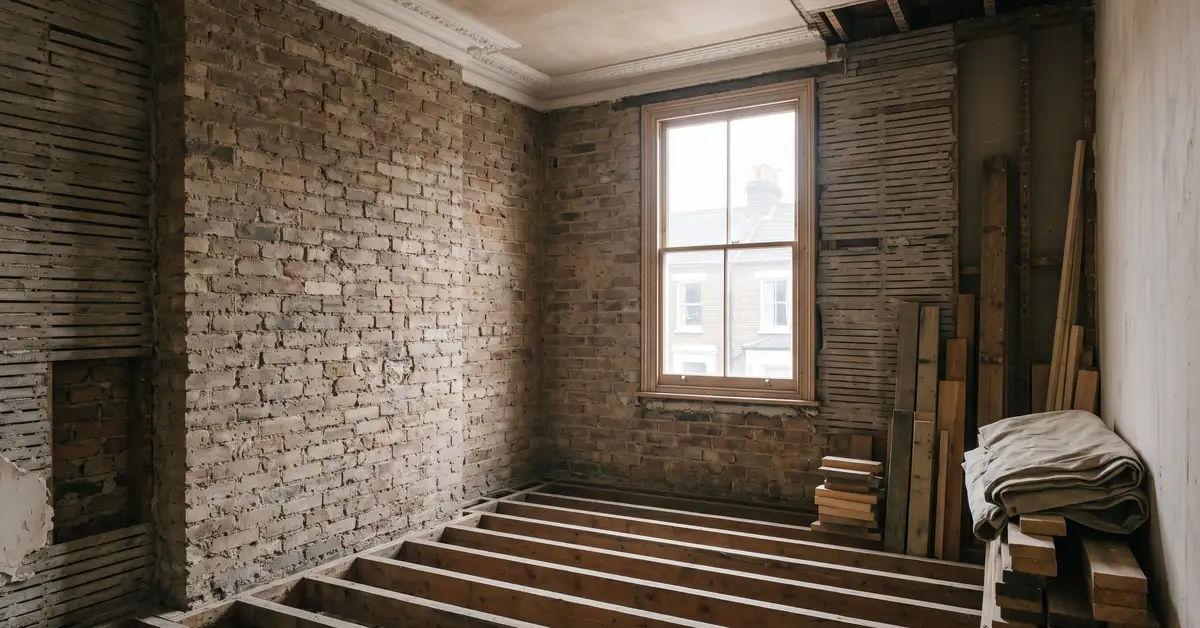
London and Kent Construction carries out full renovation and refurbishment of Victorian, Edwardian and Georgian houses and flats across London. Structural alterations, extensions, loft conversions, services and finishes sit under one contract, run by our own directly employed team, supported by specialist trades, from the first site visit to handover, including on listed buildings and in conservation areas.
Most of the whole-property renovations we carry out cost between £150,000 and £500,000, and some cost more. That is well above the national figures most people find first. Checkatrade, in its house renovation cost guide updated in September 2026, puts a three-bedroom house in the UK at £43,530 to £110,350, with an average of £76,690. A London period house often needs structural work, new services, repair of original fabric and careful access arrangements that a national average does not price. Our guide to house renovation costs in London explains where the money goes.
One renovation contract instead of four separate trades
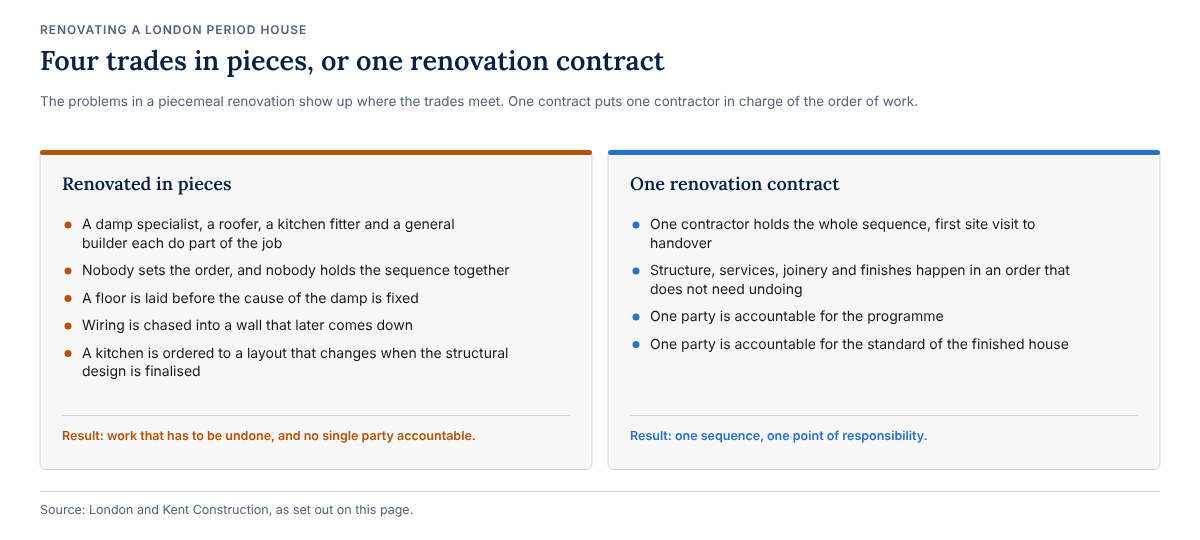
Many period houses in London get renovated in pieces. A damp specialist, a roofer, a kitchen fitter and a general builder each do part of the job, in an order nobody set, with nobody holding the sequence together. The problems show up where the trades meet: a floor laid before the cause of the damp is fixed, wiring chased into a wall that later comes down, a kitchen ordered to a layout that changes once the structural design is finalised. A full renovation and refurbishment contract puts one contractor in charge of the whole sequence, so structure, services, joinery and finishes happen in an order that does not need undoing. One party is accountable for the programme and for the standard of the finished house.
Who this renovation service is for, and who it is not for
The renovation and refurbishment service suits owners of Victorian, Edwardian and Georgian houses, mansion block flats and garden maisonettes who are taking on most or all of the property at once, usually with it empty for the main phase. It suits projects where structural alterations, an extension or a loft conversion sit inside the same contract as the refurbishment, and it suits listed buildings and conservation areas, where decisions about original fabric and consents matter as much as the building work. It is the wrong shape for emergency repairs where you need someone on site this week. It is also wrong if you want to act as your own main contractor, because the value of the service is that one contractor holds the sequence and the responsibility. Smaller jobs, such as one kitchen or one bathroom, are a separate conversation.
What a full renovation includes
Scope is set for each property. The elements below are what a full renovation of a London period property normally contains. They are priced element by element, and anything outside the agreed scope is priced in writing before it starts.
- Recording and protecting cornices, staircases, stone and original joinery before anything comes out, so what is worth keeping is identified first rather than rescued afterwards.
- Structural alterations: openings, beams, chimney breast removals, basement work and underpinning where the structural engineer specifies it.
- Extensions and loft conversions where they form part of the same project.
- Roofing, brickwork, pointing and repairs to the existing fabric.
- Period repair: lime plaster repaired rather than replaced, sash boxes overhauled and rehung, joinery made to match the original profile.
- A full rewire, replumb, heating and drainage, with underfloor heating, plant and controls set out before the floors go down.
- Plastering, flooring, tiling, kitchens, bathrooms, decoration and making good.
- Building control coordination, and handover of the certificates the works generate.
How a renovation runs, from site visit to handover
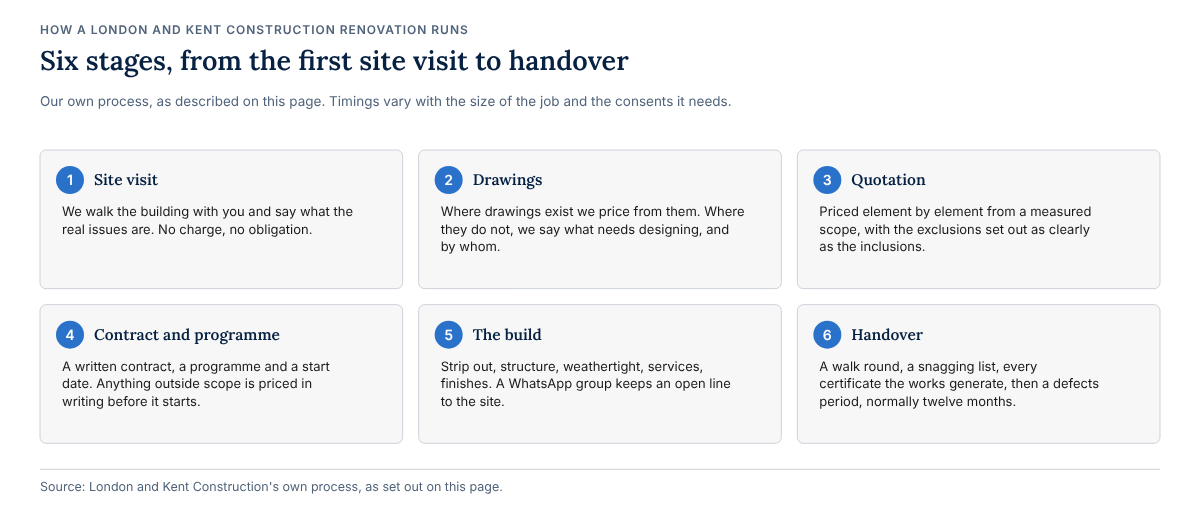
A London and Kent Construction renovation runs in six stages. It starts with a site visit: we walk the building with you and say what we think the real issues are, with no charge and no obligation. Where drawings exist we price from those. Where they do not, we say what needs designing, and by whom, before the work can be priced properly. The quotation is built element by element from a measured scope, with the exclusions set out as clearly as the inclusions. A written contract, a programme and a start date follow. On site the work runs in sequence: strip out, structure, weathertight, services, finishes, so nothing goes in that later has to come out. Every job has a WhatsApp group, so there is an open line to the people on site alongside calls and emails. At the end we walk the house with you, agree a snagging list, put it right and hand over every certificate the works generate. A defects period, normally twelve months, follows handover. Our article on how long a house renovation takes in London covers the timings.
What the homeowner is responsible for
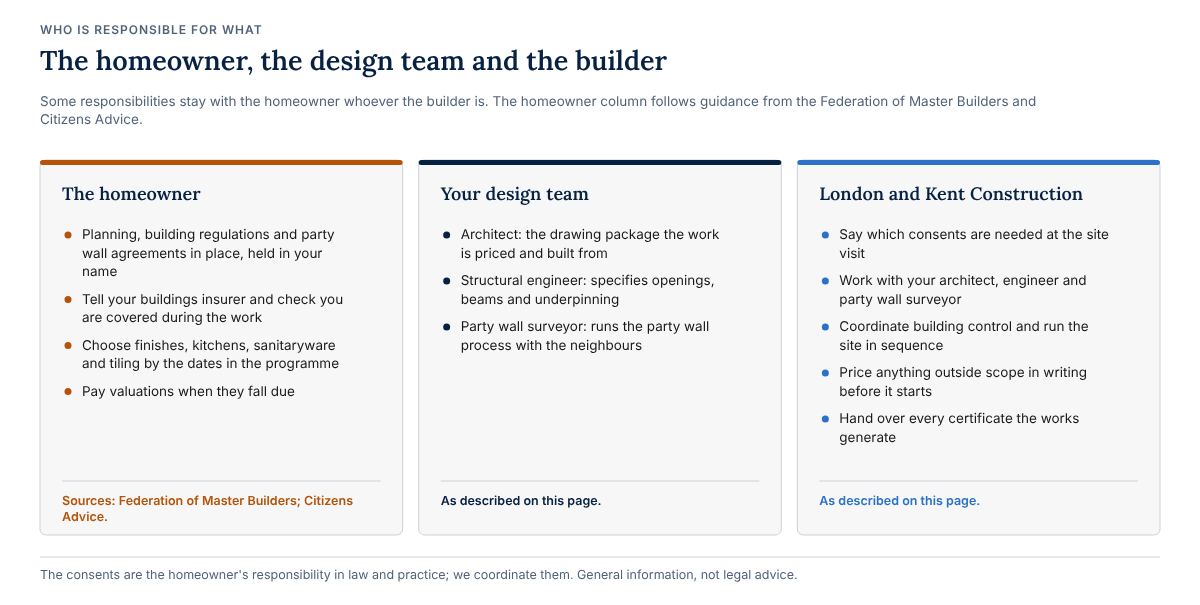
Some responsibilities in a renovation sit with the homeowner and cannot be passed to the builder. The Federation of Master Builders puts it plainly: “As the property owner, it is your responsibility to make sure the correct building regulations, planning and environmental permissions, and Party Wall Agreements are in place for the work to your home.” We say what is needed, work with your architect, engineer and party wall surveyor, and coordinate building control, but the consents are held in your name. Citizens Advice also tells homeowners to “Contact your buildings insurance company to check you'll be covered during the work.” The homeowner is accountable for decisions and their timing too: choosing finishes, kitchens, sanitaryware and tiling by the dates in the programme, and paying valuations when they fall due. In our experience, late decisions are the most common reason a renovation programme slips.
How renovation pricing is structured and what drives it
A London and Kent Construction renovation price is built from a measured scope, never from a rate per square metre applied to a whole building. The quotation prices the work element by element, so you can see what each part costs and take things out if the total is too high. On a London period house, the figure moves most with the amount of structural work, the condition of the roof and external fabric, how much original joinery and plaster is repaired rather than replaced, whether services are fully renewed, and the specification of kitchens, bathrooms and finishes. Access is a real cost on a narrow terraced street with no parking. Listed status and conservation area controls change both methods and materials. The deposit varies by project and can be up to 30 per cent, depending on the materials that have to be bought up front. It is agreed alongside the staged payment schedule, in writing, at contract stage and before any work starts.
Published market costs, for context only
The published figures below are national market ranges from independent sources, each with its date. They are not London and Kent Construction's prices and not an estimate for your property. They are useful for one thing: showing how far a national average sits from the cost of a whole London period house.
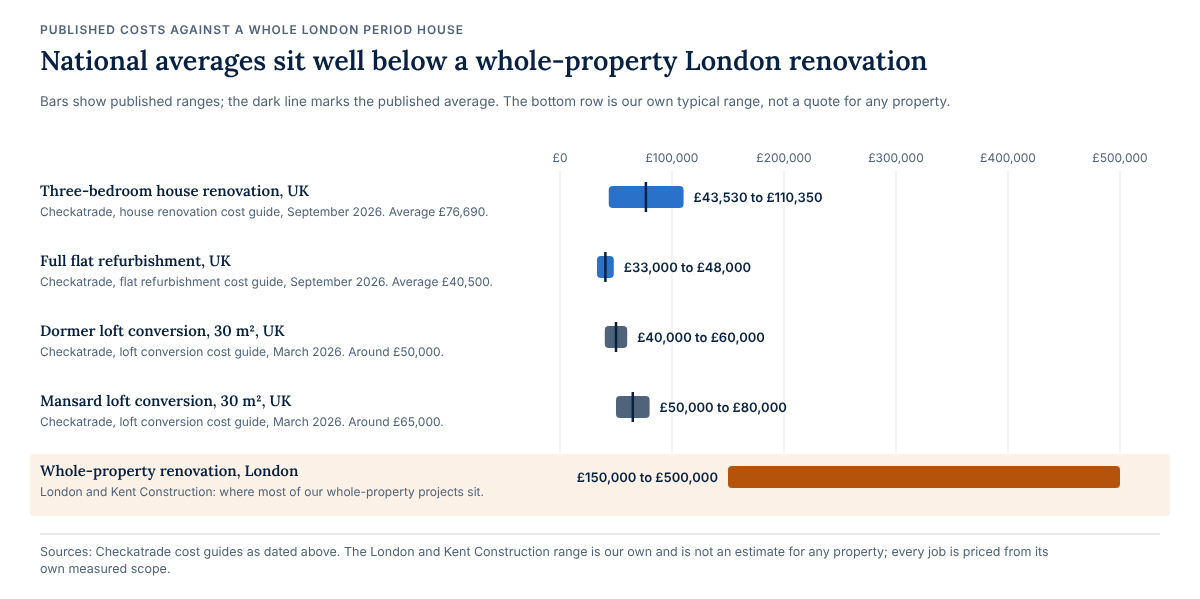
For extensions in particular, Resi put rear extensions in London and the South East at £1,900 to £3,000 per square metre in February 2026. Checkatrade advises adding 10 to 15 per cent to a renovation budget as a contingency in its September 2026 guide, and the HomeOwners Alliance advises setting aside around 10 per cent of the total cost for unexpected costs.
Taking over an unfinished renovation
Some renovation projects come to us part-built, because the original contractor stopped work or went out of business. London and Kent Construction has twice taken over unfinished projects in Notting Hill: one a substantially delayed renovation, where we corrected defective work including the electrics and completed the house, and one where we completed the decoration and second-fix snagging after the previous builder became insolvent. The existing work has to be surveyed and recorded, the structure and services checked against the drawings and the building control record, and a scope written for what must be corrected before anything new is built. We assess what has been built, say plainly what can be kept and price the rest properly, and there is no charge for the first site visit or that initial assessment. Our page on taking over a stalled site explains how it works, and our article on what to do when your builder goes bust covers the first steps.
Accreditations, and the checks you should run
London and Kent Construction Ltd is company number 04853030 and part of The New Greenwich Group. The company is a member of CHAS, the Contractors Health and Safety Assessment Scheme, and of Constructionline, both of which assess contractors against health, safety and commercial criteria, and is registered with NHBC. London and Kent Construction is not a member of the Federation of Master Builders, which is quoted on this page as independent guidance only. You can check the company number on the Companies House register, and our guide to choosing a renovation builder in London sets out the other checks worth running on any builder, including us.
Where London and Kent Construction works
Most of our renovation work is in south east London, in Greenwich, Blackheath, Eltham, Charlton and Lewisham, and a growing share is in south west and west London, including Notting Hill, Hammersmith, Fulham and Chelsea. Our area pages cover the local housing stock and planning position in Greenwich and Blackheath, Battersea, Clapham and Wandsworth and Kensington and Chelsea.
Frequently asked questions
How much does a full renovation with London and Kent Construction cost?
Most whole-property renovations we carry out cost between £150,000 and £500,000, and some cost more. Where a project sits depends on the structural work, the services, the condition of the fabric and the finishes. Every job is priced from its own measured scope after a site visit.
Do I need an architect before you can quote?
Not to visit and advise, but a full renovation usually needs a drawing package before anyone can price it accurately. Quotes priced from incomplete drawings are not comparable with each other, so the design comes first. We will tell you at the site visit what needs designing.
Can we stay in the house during the renovation?
It depends on the scope. Renovations involving structural work, a full rewire and a replumb are normally done with the house empty. Phased work on part of a house can sometimes be lived through, and we will say honestly at the site visit which applies.
Do you work on listed buildings and in conservation areas?
Yes. London and Kent Construction works on Victorian, Edwardian and Georgian houses, including listed buildings. Listed and conservation area work changes methods, materials and consents, so it is planned into the scope from the start rather than discovered on site.
Is London and Kent Construction a member of the Federation of Master Builders?
No. The company is a member of CHAS and Constructionline and is registered with NHBC. The Federation of Master Builders is quoted on this page as independent guidance, and no membership of it is claimed.
What to do next
The next step is a site visit. We will walk the property with you, say what we think the real issues are, and tell you what needs designing or investigating before the work can be priced. Book a site visit, or call 020 8850 7064 or email team@londonandkent.co.uk if you would rather talk first.