

London and Kent Construction renovates stucco fronted terraces, mansion block flats, mews houses and garden square properties across the Royal Borough of Kensington and Chelsea. Full refurbishment, structural alterations and extensions run under one contract. In a borough where nearly three quarters of the land is in a conservation area, consents, methods and site logistics are settled before anything is ordered.
Most of the whole-property projects we carry out cost between £150,000 and £500,000, and some cost more. That is well above the national averages. Checkatrade, in its cost guide updated in September 2026, puts a three-bedroom house renovation in the UK at £43,530 to £110,350, and a full flat refurbishment at £33,000 to £48,000 in a separate guide. Our renovation and refurbishment page sets out what is included and how a project runs.
The housing stock in Kensington and Chelsea
Four kinds of building make up most of the work in the Royal Borough. Stucco fronted terraces and garden square houses run to four and five storeys, with rendered lower elevations, iron balconies and original sash boxes; the front elevation is often the controlled part, so work is planned from the inside out and external repairs are specified to match rather than replace. Mansion block flats in Kensington, Earls Court and Chelsea have shared structure and shared risers, so the lease and the freeholder decide what can move before the scope is priced. Mews houses have small footprints, difficult access and neighbours on three sides, so deliveries, skips and scaffold are a programme item in their own right. And across all three, listed status and basement controls decide what is possible before anyone discusses what is preferable. Our own west London work includes a Chelsea mansion block refurbishment covering brickwork, pointing, roof works and the communal areas.

Conservation areas across most of the borough
Conservation area status is the starting point for almost any external work here. The Royal Borough of Kensington and Chelsea says it has “nearly three quarters of the borough protected by 38 separate conservation areas.” Some of those areas also carry Article 4 directions. The council explains that in conservation areas its Article 4 directions “aim to control small scale changes to the outside of houses that would otherwise harm the historic or architectural character of the conservation area. Such works can include changing windows, front doors, removing / rebuilding boundary walls, roof coverings or other works, often to the front elevations.” The directions are street specific and include a number of mews. Front elevations matter in the detail too. The council's Ladbroke Conservation Area Appraisal, adopted in October 2015, notes that stucco ground floors are “generally” painted “a uniform white or off-white to the whole terrace”, and lists “Stucco houses painted dark colours or non-uniform colours” among the negative features in that area. Each conservation area has its own appraisal, so the one for your street is worth reading before a colour or a window is chosen.
Basements in Kensington and Chelsea
Basements are the most tightly controlled work in the borough. The council's Article 4 directions page explains that it made a direction “to remove permitted development rights for basement extensions” to single dwelling houses across the borough, which “came into force on 28 April 2016” and “applies to the entire area of the Royal Borough”. Every basement therefore needs a planning application. The council's Local Plan, adopted on 24 July 2024, sets the limits in Policy CD11: a basement must “not exceed a maximum of 50 per cent of each garden or open part of the site”, must “not comprise more than one storey”, with exceptions possible on large sites, must “not involve excavation underneath a listed building (including vaults)” and must “include a minimum of one metre of soil above any part of the basement beneath a garden”. A basement also brings party wall notices for excavation near the neighbours, and the borough's construction rules described below.

Mews houses and mansion block flats
Mews houses have a character the council protects closely. Its Kensington Conservation Area Appraisal, adopted in February 2017, warns that “Loss of carriage doors and the addition of too many windows or elements associated with housing can harm this fragile charm and give the mews the look of any other type of housing”. On a mews the practical work is about access: narrow cobbled lanes, no parking and neighbours close on every side, so the programme is built around deliveries and waste. Mansion block flats raise a different question, which is what the lease allows. The Planning Portal states that “the permitted development rights which apply to many common projects for houses do not apply to flats”, and gov.uk notes that “Your lease will tell you what conditions you've agreed to, for example: if you need permission to make alterations”. In a mansion block the freeholder or managing agent will usually approve the scope, the working hours and any change to shared services.
The borough's Code of Construction Practice
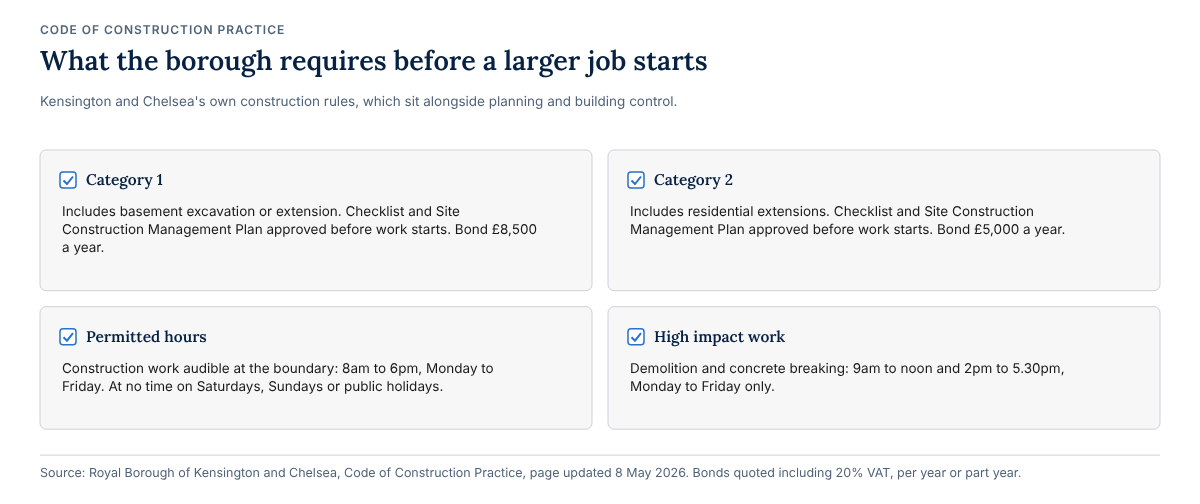
Kensington and Chelsea runs a Code of Construction Practice that applies to larger domestic jobs, and it shapes the programme before work starts. Category 1 includes “Basement excavation or extension”, and Category 2 includes “Residential and commercial extensions”. The council states that “For Category 1 and 2 sites, a signed copy of the code checklist ... together with a Site Construction Management Plan (SCMP) must be submitted to and approved by the council before works can start.” A construction bond applies: “£8,500 including 20% VAT per year or part year” for domestic Category 1 schemes and “£5,000 including 20% VAT per year or part year” for Category 2. Construction work audible at the site boundary is limited to “8am to 6pm, Monday to Friday” and “At no time on Saturdays, Sundays and Public Holidays”, with demolition and concrete breaking held to “9am to noon and 2pm to 5.30pm” on weekdays. We plan the paperwork, the hours and the bond into the programme from the first site visit.
Pre-application advice and fees
On a listed building, a conservation area scheme or a basement, pre-application advice is usually worth the fee. The council's 2026 to 2027 charges for householders, including VAT, are £587.00 at Level 1 and Level 2 and £714.00 at Level 3, rising to £758.10, £1,143.50 and £1,270.50 where subterranean work is involved. The council notes that “Level 1 is not available for alterations to listed buildings.” The householder planning application fee in England is £548 from 1 April 2026, according to gov.uk, and listed building consent carries no fee, according to Historic England.

Taking over an unfinished project in west London
Some of our west London work has come to us part-built. London and Kent Construction has twice taken over unfinished projects in Notting Hill. One was a substantially delayed renovation, where we corrected defective work, including the electrics, and completed the house. On the other, the previous builder had become insolvent, and we completed the decoration and second-fix snagging. In that situation we assess and record what exists, check the structure and services against the drawings and the building control record, say plainly what can be kept and price the rest properly. Our page on taking over a stalled site explains how we approach it, and our article on what to do when your builder goes bust covers the first steps.
Frequently asked questions
Do I need planning permission for a basement in Kensington and Chelsea?
Yes. The council removed permitted development rights for basements across the whole borough from 28 April 2016, so every basement needs an application. Policy CD11 limits it to one storey and half of each garden, with none under a listed building.
Can I change the windows or front door of my house?
It depends on the street. Much of the borough is in conservation areas, and some carry Article 4 directions controlling windows, front doors, boundary walls and roof coverings. Check the direction and the conservation area appraisal for your street before choosing a replacement.
Do you work on mansion block flats?
Yes. Our west London work includes a Chelsea mansion block refurbishment. In a flat, the lease and the freeholder's consent decide what can change, so we price once the managing agent's terms are known.
What does a renovation cost in Kensington and Chelsea?
Most whole-property projects we carry out cost between £150,000 and £500,000, and some cost more. Basements, listed buildings and the borough's construction rules all add to the programme, so every job is priced from its own measured scope after a site visit.
What to do next
If you own a house, mews or flat in Kensington and Chelsea and want to know what your renovation involves, book a site visit. We will walk the property with you, tell you which consents and construction rules apply, check what the lease allows if it is a flat, and set out how we would sequence and price the work. Book a site visit, call 020 8850 7064 or email team@londonandkent.co.uk.