
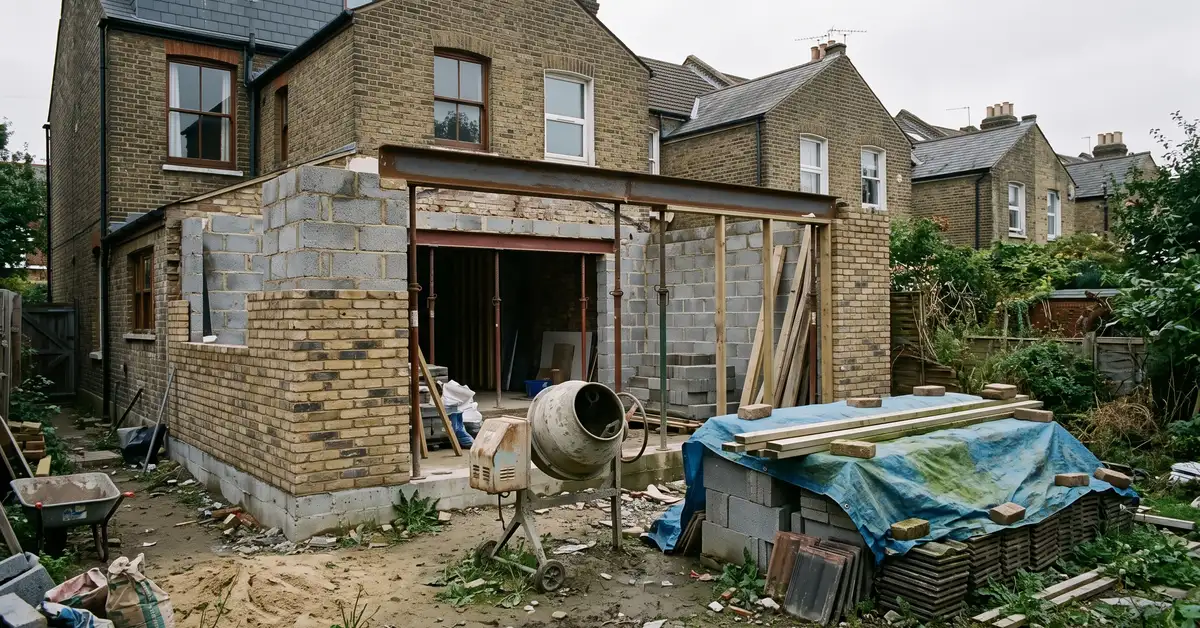
If your builder has gone bust mid project, stop further payments, secure the site, gather every document and photograph the work as it stands, then get an independent assessment of what has actually been built before anyone else quotes. London and Kent Construction have taken over abandoned sites and an accurate record is what makes a rescue possible.
A builder failing partway through a job is not unusual. The Insolvency Service recorded 3,841 construction company insolvencies in England and Wales in the 12 months to July 2026, 17 per cent of cases where the industry was captured, the most of any industry (Insolvency Service, Company Insolvency Statistics July 2026, published 18 August 2026). Citizens Advice found that 28 per cent of people who hired a trader in the previous 18 months experienced an issue, around 4.8 million homeowners, of whom around 1.7 million paid more to fix earlier work or were overcharged (Citizens Advice, 7 July 2026). What follows is the practical order of work.
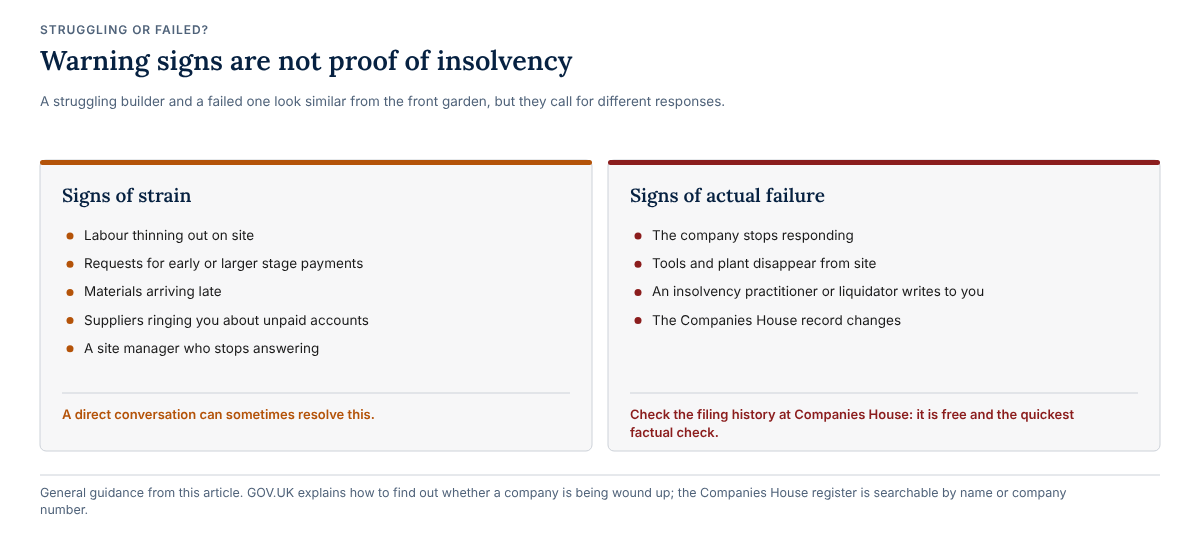
What to do in the first two days
If your builder has stopped turning up and you think the business may have failed, take these steps in order.
- Stop further payments, including standing orders and stage payments and do not release money in the hope it brings people back.
- Make the site safe: scaffolding, open roofs, trenches, unsupported structure, exposed wiring, gas and water.
- Photograph and video everything, dated, including materials on site.
- Collect the paperwork in one place: contract, quotes, drawings, invoices, payment records and messages.
- Write to the builder at their registered address and by email, asking for their position.
- Tell your building control body and your insurer that work has stopped.
- Get independent advice before signing anything new.
Do not let another contractor start work or clear the site until the record is complete.
Telling the difference between a builder who is struggling and one who has failed
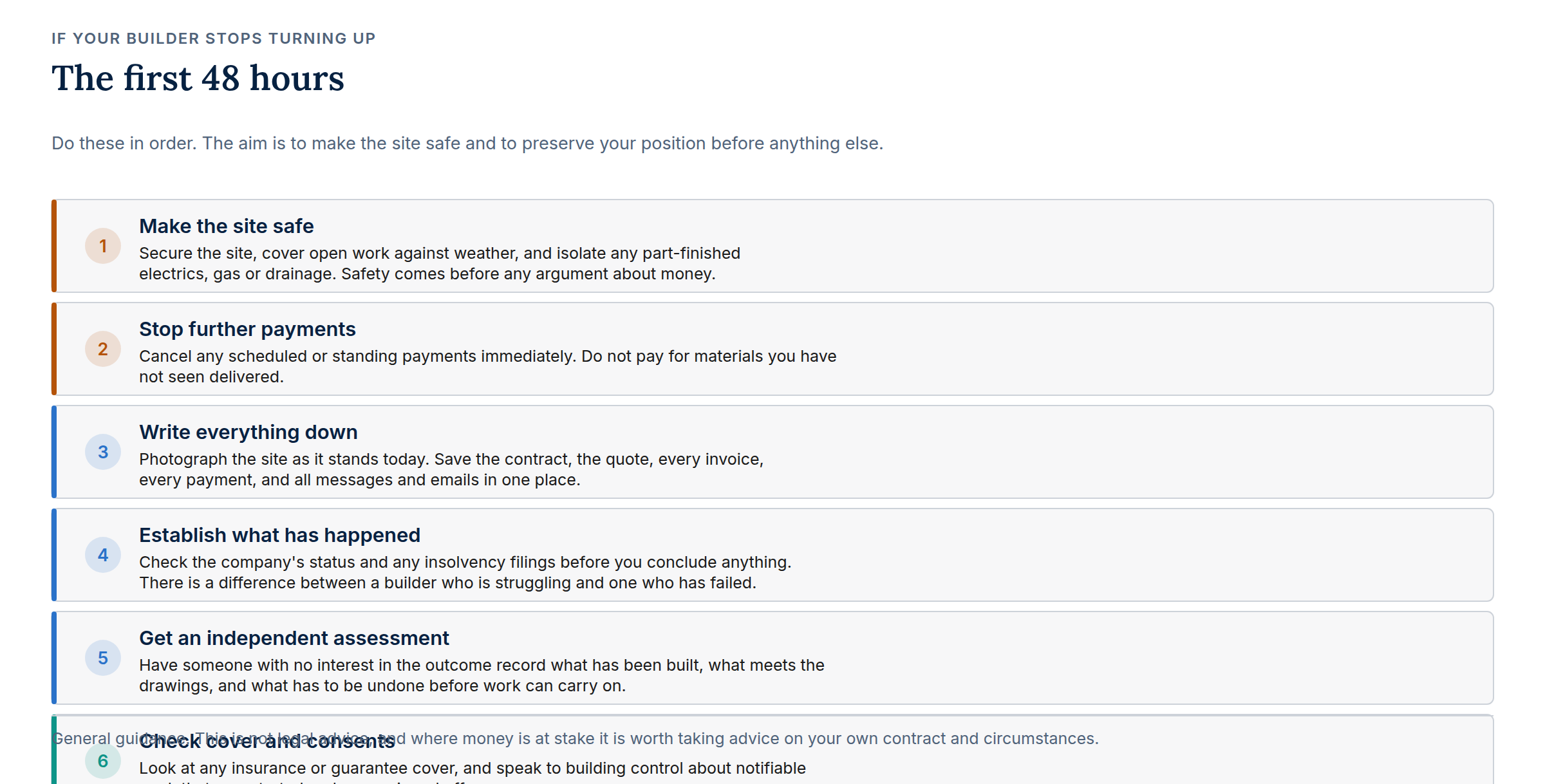
A struggling builder and a failed builder look similar from the front garden, but they call for different responses. Signs of strain include labour thinning out, requests for early or larger stage payments, materials arriving late, suppliers ringing you about unpaid accounts and a site manager who stops answering. Those are warning signs rather than proof of insolvency and a direct conversation can sometimes resolve them. Actual failure shows differently: the company stops responding, tools and plant disappear, an insolvency practitioner or liquidator writes to you, or the Companies House record changes. Checking the filing history at Companies House is free and is the quickest factual check available. Search the Companies House register by name or company number. GOV.UK guidance, updated in October 2026, explains how to see whether a company is being wound up.
Securing the site and making it safe
When a builder leaves a part completed job, practical responsibility for site safety falls back to you, because you are the one who is there. Deal with the physical risks first. Scaffolding belongs to whoever hired it, so contact the scaffold company to establish whose account it is on and whether it is still insured and inspected. Cover open roofs against weather and fence or board trenches. Have temporary propping and unsupported structure looked at by a structural engineer rather than assumed adequate. Have gas and electrical work made safe by a registered installer. Lock materials away and if children can get in, secure the perimeter the same day. Under the CDM Regulations 2015, the HSE explains in guidance updated in October 2025 that a domestic client's duties normally pass to the contractor or principal contractor. Once the builder has gone, agree in writing who controls the site before anyone restarts.
Money already paid, deposits and stage payments
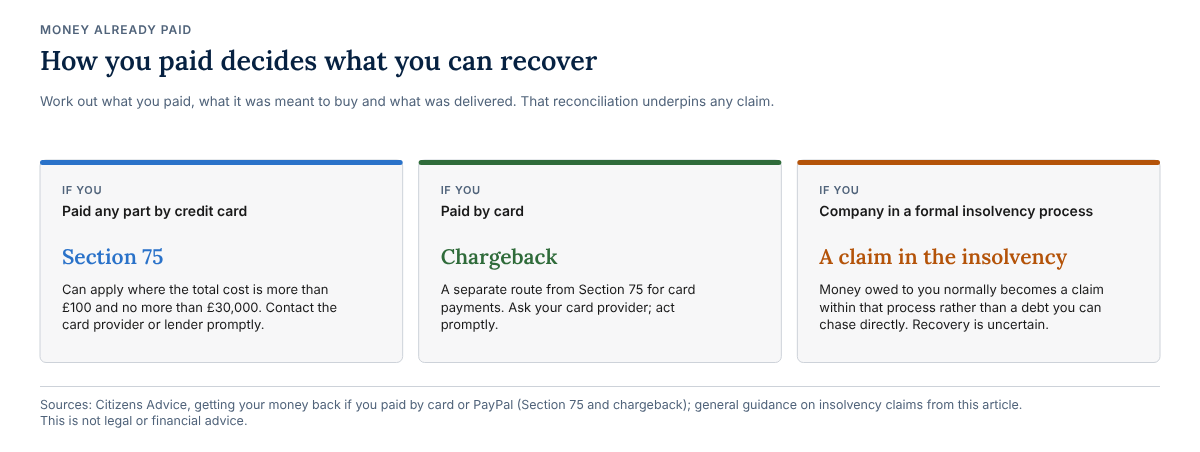
Money already paid to a builder who has failed is the hardest part of this situation. It helps to be realistic early. If the company has entered a formal insolvency process, money owed to you normally becomes a claim within that process rather than a debt you can chase directly and recovery is uncertain. That is why deposit discipline matters before appointing anyone: the HomeOwners Alliance advises "around 10% is usually reasonable and don't pay more than 25%" (HomeOwners Alliance, June 2025). Work out what you have paid, what it was meant to buy and what was delivered, because that reconciliation underpins any claim. How you paid decides what you can recover. Citizens Advice says Section 75 can apply if you paid any part by credit card and the total cost is more than £100 and no more than £30,000. Chargeback is a separate route for card payments. Contact your card provider or lender promptly.
Where you stand contractually
Your contractual position after a builder fails depends on what was written down, which is why a written contract matters more now than at any other point. A contract should cover, in the words of the HomeOwners Alliance, "what is in and out of scope, how much the work will cost and how payments will be made, start and completion dates, who is responsible for obtaining and paying for various consents and fees ... and critically whether the correct insurance policies are in place before work starts" (HomeOwners Alliance, January 2024). If all you have is a quote and an email trail, that is still evidence. Take advice on termination before writing to the builder to end the contract, because how you end it affects what you can claim afterwards.
The evidence to gather now
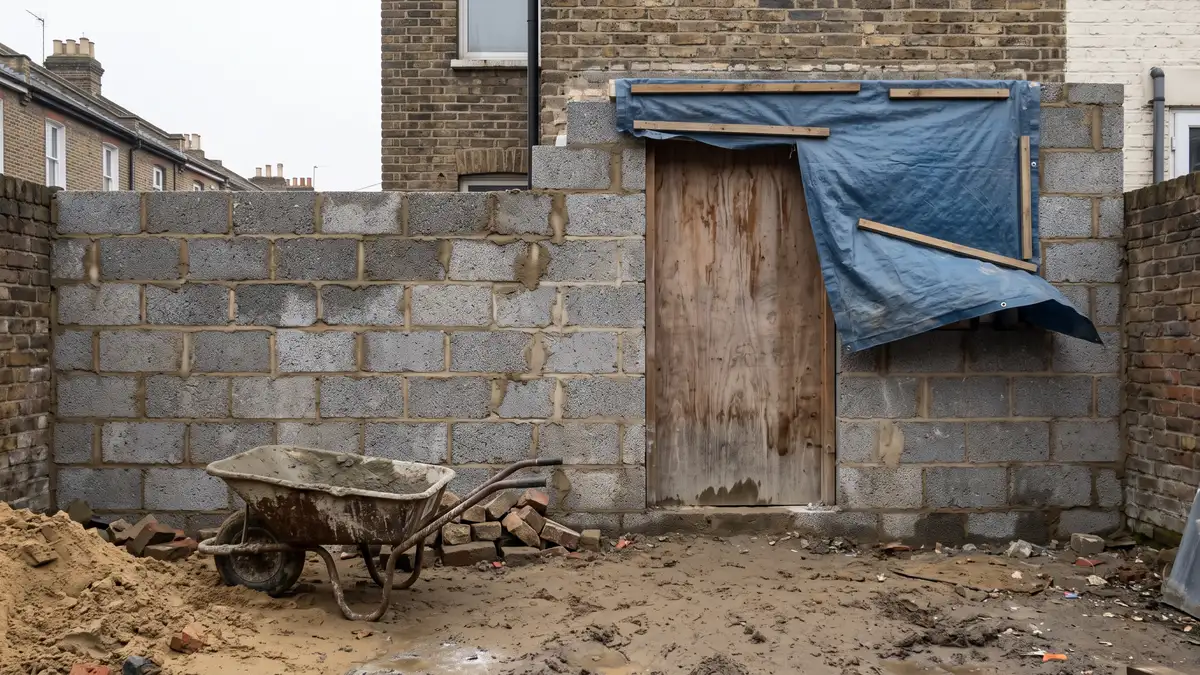
Evidence gathered in the first week after a builder disappears is worth more than anything reconstructed later, so treat it as a task in its own right. Assemble the contract or quote and any revisions, drawings and specifications, the payment schedule, every invoice and receipt, bank records showing what left your account and when, all texts, emails and messages including those agreeing variations verbally, delivery notes, any certificates issued and your building control application and inspection records. Add a dated photographic record, room by room and a note of who was on site and when work stopped. If a subcontractor or supplier contacts you directly about unpaid accounts, keep that correspondence as well and do not pay them without taking advice first.
Insurance cover and guarantees
Insurance and guarantee cover after a builder's failure depends on what was in place before work started, so check the policies. Read your own buildings insurance terms, because many restrict cover while a property is undergoing major work or is unoccupied. If the builder gave a warranty, the question is whether an insurer stood behind it or it was only the company's own promise, which ends when the company does. The Federation of Master Builders says an insurance backed guarantee covers you "to fix structural defects in the event your builder is no longer able to fix them under their warranty, for example if they go out of business or retire" (Federation of Master Builders, current). Find the certificates, or contact the scheme named on your paperwork.
Building control and part completed notifiable work
Part completed notifiable work has to be regularised through building control and leaving it unresolved causes trouble years later when you sell. Contact your building control body, the local authority or an approved inspector, tell them the contractor has left and ask what inspections were carried out and what evidence they need for work now covered up. Foundations, structural openings, drainage and insulation are most often buried before inspection and an inspector may accept opening up, an engineer's report or other evidence. Notifiable electrical and gas work without certificates will need testing and certification by a registered installer. Keep everything the building control body sends you. CNC Building Control, in guidance updated in September 2025, says the building control body must be told if the client, contractor or designer changes during the work. Tell yours before anyone restarts and ask what inspection records it holds.
Getting an honest assessment of what has been built
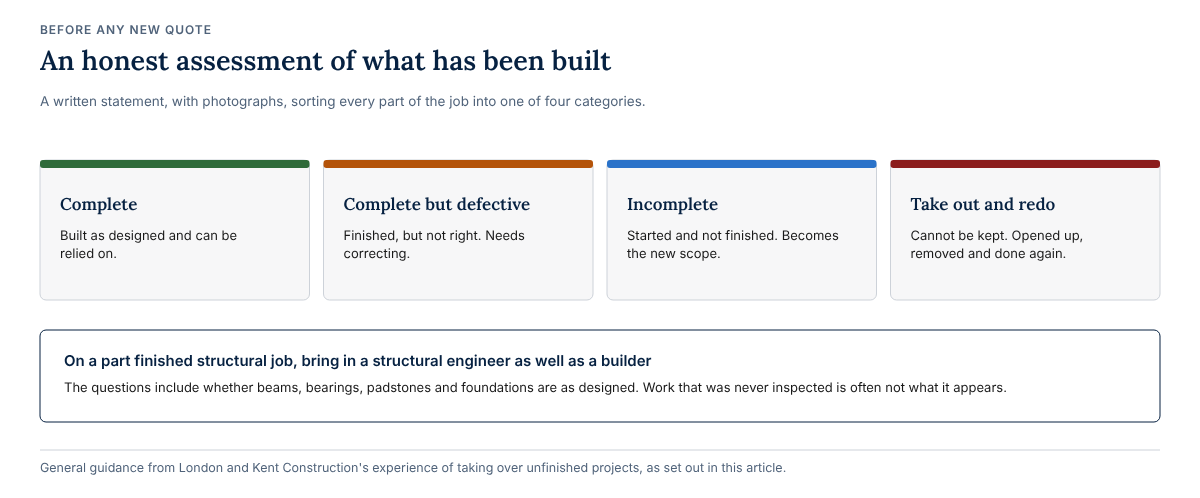
An honest assessment of what has actually been built turns a frightening situation into a manageable one. It should come before any new quotes. You need a written statement of what is complete, what is complete but defective, what is incomplete and what must be taken out and done again. On a part finished structural job that usually means a structural engineer as well as a builder, because the questions include whether beams, bearings, padstones and foundations are as designed. Expect it to be uncomfortable: work that was never inspected is often not what it appears. Ask for it in writing, with photographs.
One example from our own work: a large Notting Hill townhouse was still unfinished around two years into a nine month programme when we took it on. Close inspection found electrical work signed off despite being unsafe, chipboard reused from Notting Hill Carnival boarding laid under a shower tray and a speaker system fitted with cheap substitutes. We put the defects right, reworked and certified the electrics and finished the house in around two to three months.
Bringing in another builder to finish the work
Bringing in another builder to finish a part completed job is a different exercise from tendering a fresh project. A contractor taking over needs the assessment, the drawings and specification, the building control correspondence and a clear statement of what is being handed over and time on site before quoting. Expect a takeover to cost more per unit of remaining work than the original contract, because someone has to unpick, correct and stand behind work they did not do. Get more than one price on the same information: the HomeOwners Alliance advises "you'll want to get at least three builders' quotes for your project" (HomeOwners Alliance, August 2024). Agree in writing what the new contractor is and is not responsible for.
A second Notting Hill job was a flat where the previous builder had gone out of business. The work already done was sound, so we picked up where they had left off and finished the decoration, second fix and snagging in around six weeks.
Reducing the risk before you appoint anyone
Reducing the risk of a builder failing mid project is mostly about how you appoint and how you pay and none of it removes the risk. Check the company at Companies House, including accounts and filing history. Ask to see insurance certificates: the Federation of Master Builders advises "Always ask to see certificates, including one that shows public liability cover" (Federation of Master Builders, current). Keep the deposit within the HomeOwners Alliance guidance set out above. Use a written contract, pay against work completed rather than in advance and ask whether an insurance backed guarantee is available. London and Kent Construction are members of CHAS, Constructionline and NHBC and our approach to appointment is set out in choosing a renovation builder in London.
Frequently asked questions
How do I check whether my builder has actually gone bust?
Check the company's record and filing history at Companies House, which is free and look for insolvency filings or a change of status. A letter from a liquidator or insolvency practitioner is the clearest confirmation available.
Will I get back the money I have already paid?
Possibly not in full. Once a company is in a formal insolvency process, money owed to you usually becomes a claim within that process and recovery is uncertain. Take advice early and reconcile what you paid against what was delivered.
Can another builder simply carry on from where the last one stopped?
Not straight away. A new contractor needs an independent assessment of what is built, the drawings, the building control position and a written scope. Some earlier work may have to be opened up or redone.
Who is responsible for building control if the builder has gone?
Responsibility for consents and regulations sits with the property owner. Contact your building control body, tell them the contractor has left and ask what inspection evidence they need for work that is now covered up. Keep all correspondence.
What to do next
If work has stopped on your house, the next step is a written assessment of what has actually been built, before any new contract is signed. London and Kent Construction works on period houses and structural alterations across south east London, including projects left part complete by another contractor. See also our guide to renovating a Victorian house in London and our renovation and refurbishment page. To have the site looked at, book a site visit, or call 020 8850 7064.