
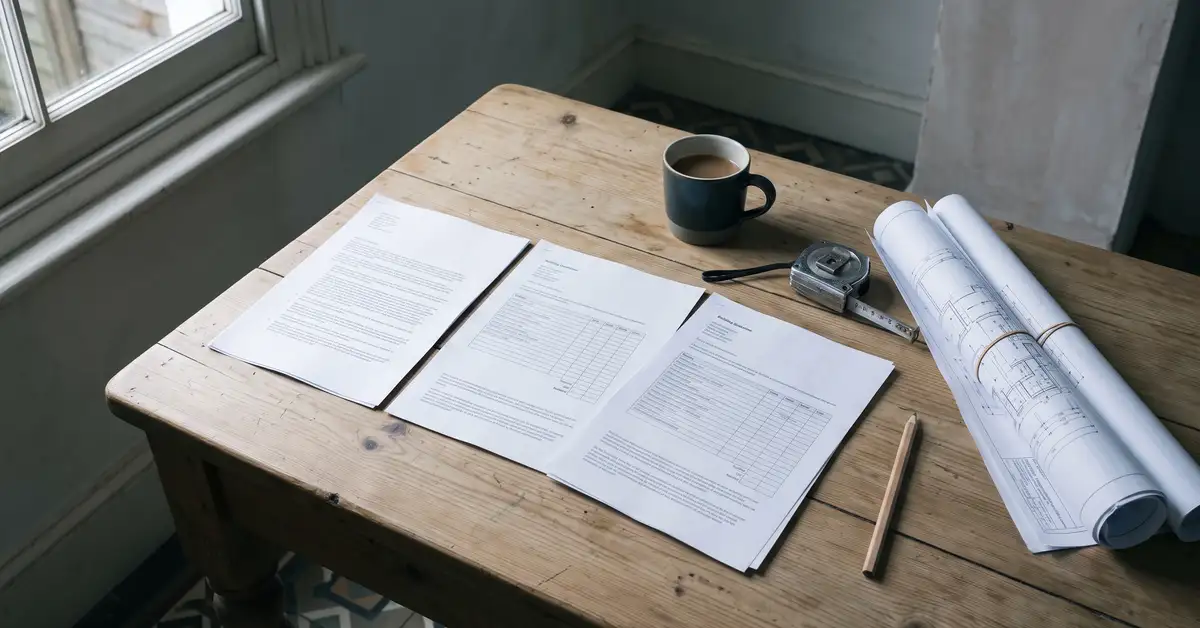
To choose a builder for a renovation in London, shortlist about five, get at least three detailed written quotes priced from the same drawings, check each company's registration, insurance and accreditations and put a written contract in place before work starts. London and Kent Construction expects to be checked the same way.
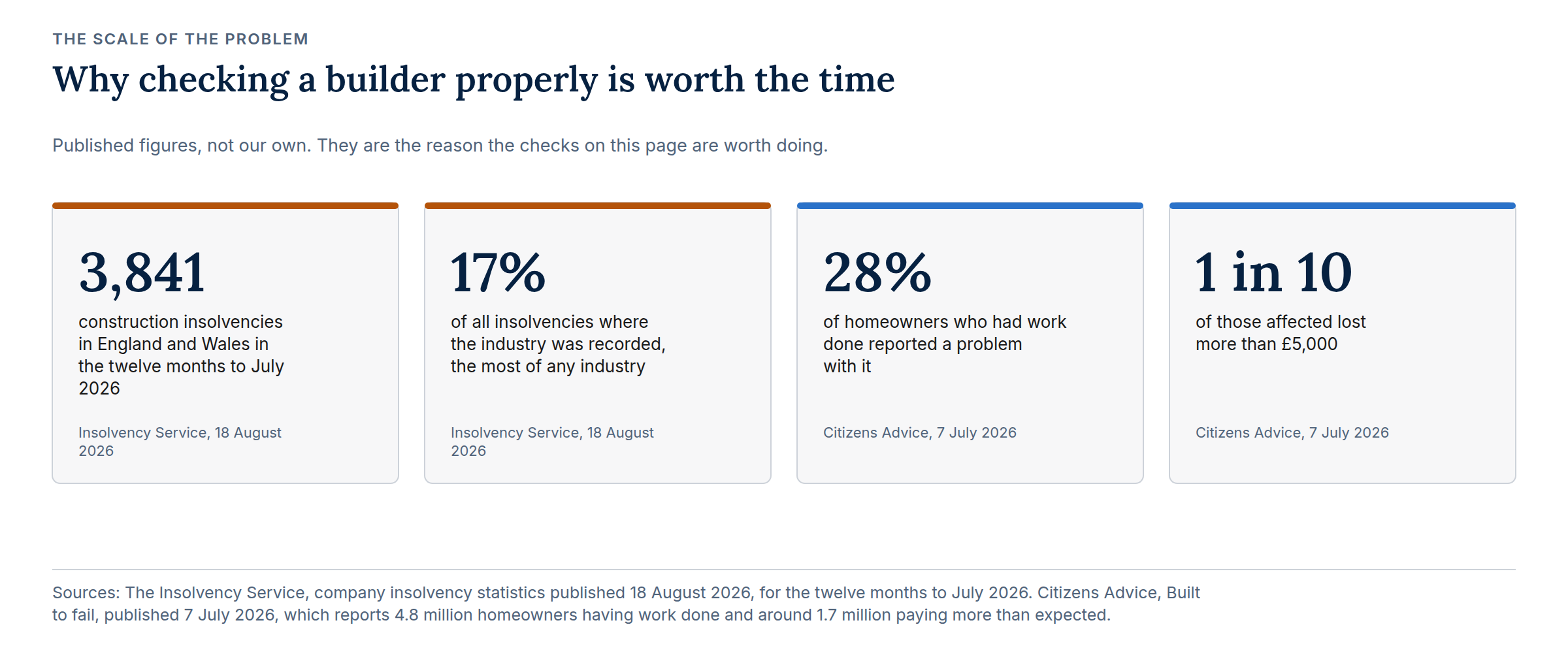
Citizens Advice, in its report Built to fail, published on 7 July 2026, found that 28 per cent of people who hired a trader for work on their home in the previous 18 months experienced an issue. The accompanying press release put the number of homeowners who faced a problem in the last 18 months at 4.8 million and around 1.7 million paying more to fix earlier work or being overcharged.
How many builders to approach and how many quotes to get
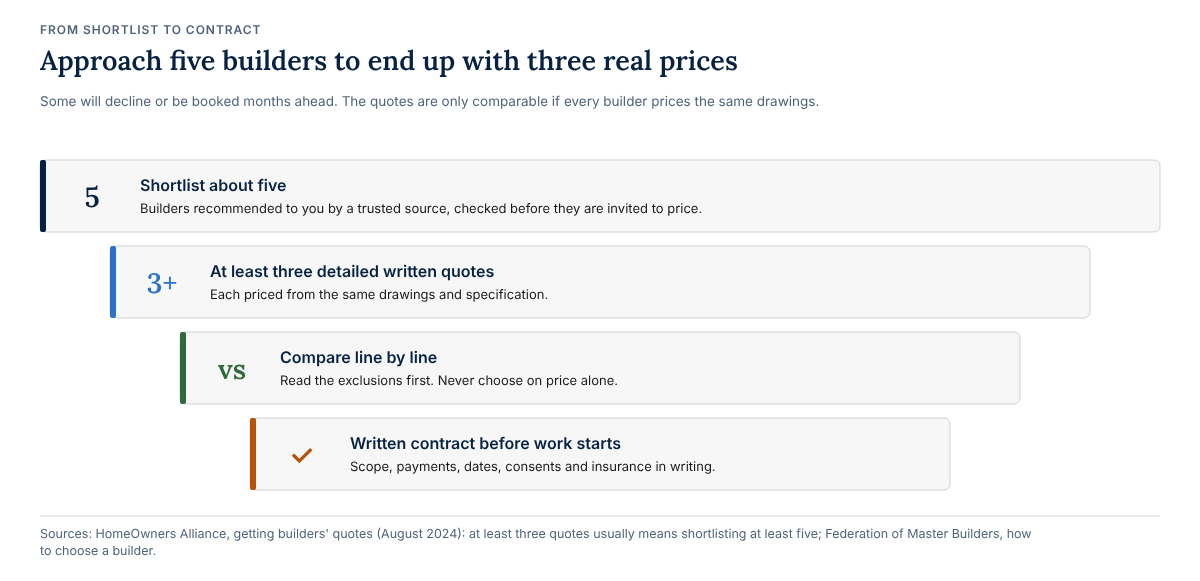
Approach more builders than you intend to use. The HomeOwners Alliance, in guidance from August 2024, says "you'll want to get at least three builders' quotes for your project and to achieve this you'll probably have to draw up a shortlist of at least five potential builders to invite to tender for the work". The Federation of Master Builders sets the same floor and adds where the names should come from: "You should always get a minimum of three quotes from builders that have been recommended to you by a trusted source." Five approaches and three quotes is the working shape for a London renovation. Expect some of the five to decline, because renovation contractors are often booked months ahead.
Why the lowest price is the quote to examine hardest
The lowest quote is not automatically wrong, but it needs the most examination, because a low number usually means something has been left out. The Federation of Master Builders puts it directly: "Get detailed written quotations from at least three builders, compare what each includes and never choose on price alone." Gaps normally come from the information the builders were given. Hampstead Architecture, writing in June 2026, says "the single biggest protection against cost surprises is tendering from a complete package. If builders price from incomplete drawings, their quotes are not comparable and the cheapest number often hides the most assumptions." So compare quotes line by line and look for items in one and not the others: structural steel, scaffolding, waste, making good, decoration, VAT and allowances for kitchens, bathrooms and tiling. An allowance is not a price. Our guide to house renovation costs in London covers the cost side in detail.
What to verify before anyone joins your shortlist
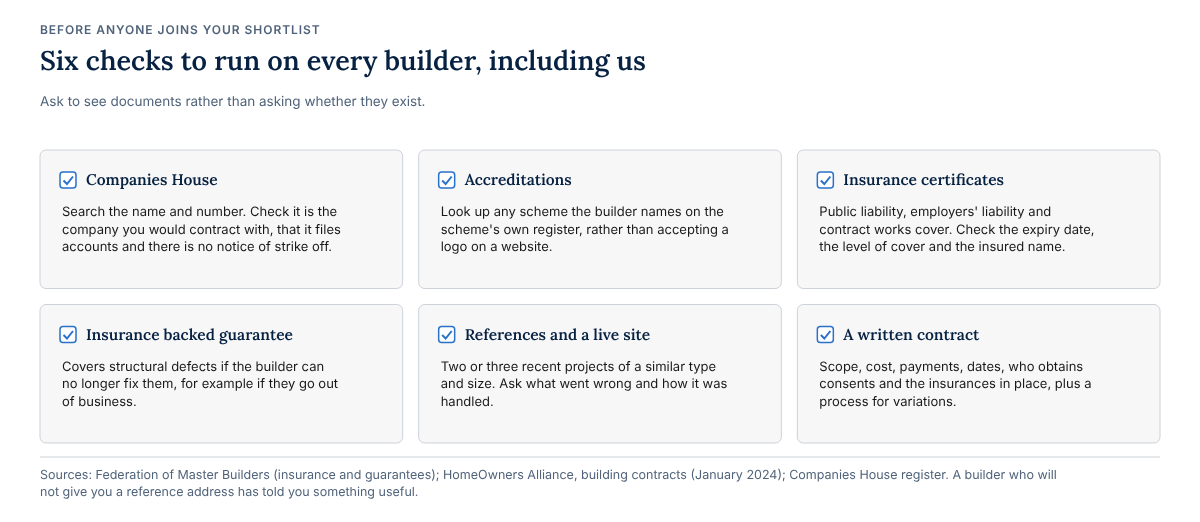
Verification is quick and worth doing before you invite anyone to price. Search the company name and number on the Companies House register. Check that the company quoting is the company you would contract with, that it files accounts and that there is no notice of strike off. Look up any accreditation the builder names on the scheme's own register rather than accepting a logo on a website. Ask for the addresses of two or three recent projects of similar type and size, then speak to those clients and ask what went wrong and how it was handled, not just whether they were happy. Ask to visit a live site if one is running. A builder who will not give you a reference address has told you something useful.
The certificates and cover to ask to see
Ask to see documents rather than asking whether they exist. The Federation of Master Builders is explicit: "Do they have insurance? Always ask to see certificates, including one that shows public liability cover." Check the expiry date, the level of cover and that the insured name matches the company giving you the quote. Ask separately about employers' liability cover and contract works cover for the building work itself. Ask whether any warranty on the finished work is insurance backed, because the FMB explains that an insurance backed guarantee covers you "to fix structural defects in the event your builder is no longer able to fix them under their warranty, for example if they go out of business or retire". A warranty from a company that no longer exists is worth nothing, which is the point of the insurance behind it.
Deposits and how to structure payments
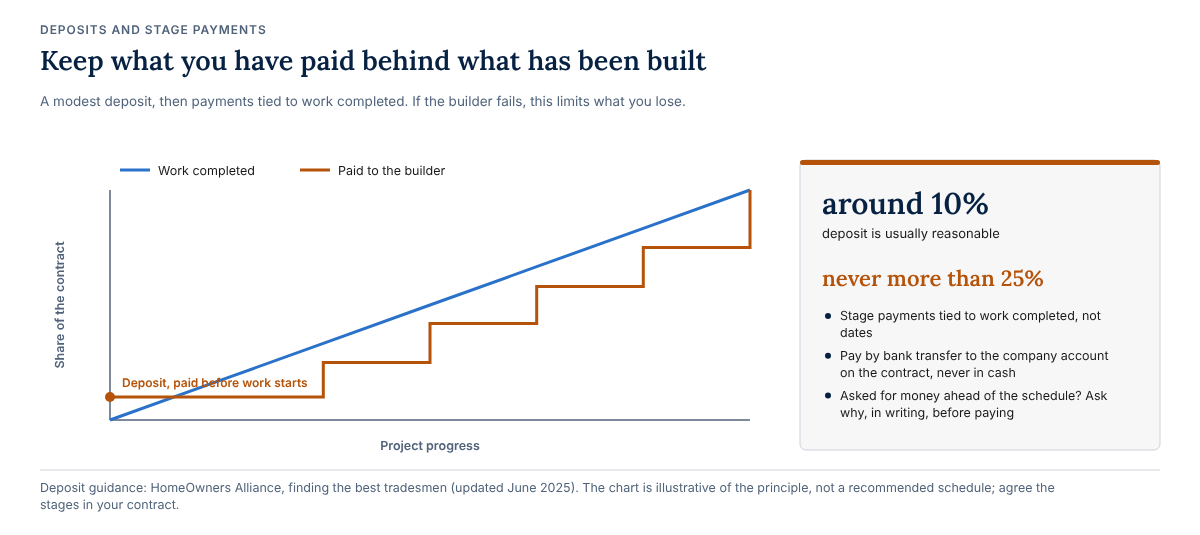
Deposits are where homeowners lose money fastest, so treat the deposit as a decision rather than a formality. The HomeOwners Alliance, in guidance updated in June 2025, advises that on a deposit "around 10% is usually reasonable and don't pay more than 25%". Beyond the deposit, agree a payment schedule tied to work completed or stages reached rather than to dates in a calendar and keep payments behind the work rather than ahead of it. Ask what the deposit is for: materials ordered, a specialist item with a long lead time, or cash flow. Pay by bank transfer to the company account named on the contract, never in cash. If you are asked mid project for money ahead of the agreed schedule, ask why in writing before paying.
Why a written contract matters and what it should cover
A written contract is the difference between a disagreement and a dispute you cannot resolve. The Federation of Master Builders states: "You should always enter into a written contract with your builder so that everybody involved in the project understands what has been agreed." The HomeOwners Alliance, in guidance from January 2024, sets out what the contract should cover: "what is in and out of scope, how much the work will cost and how payments will be made, start and completion dates, who is responsible for obtaining and paying for various consents and fees ... and critically whether the correct insurance policies are in place before work starts". Add a written process for variations, so any change to the scope is priced and signed off before it is built. Unpriced variations are the most common source of argument on a renovation.
Who is responsible for planning, building regulations and party wall matters
Responsibility for consents sits with the homeowner, not the builder. The Federation of Master Builders states: "As the property owner, it is your responsibility to make sure the correct building regulations, planning and environmental permissions, and Party Wall Agreements are in place for the work to your home." In practice your architect handles the planning application and your party wall surveyor handles the awards, while the builder works to the approved drawings and to building control. Gov.uk lists the householder planning application fee in England as £548 from 1 April 2026 and prior approval for a larger home extension as £249 from the same date. Fees are reviewed annually, so check the current figure before applying. Ask each builder how they expect to work with your architect and who will deal with building control inspections.
What realistic timescales look like
Ask for a programme, not a promise. The Federation of Master Builders, in guidance from February 2026, gives extension timescales as about three months for smaller and simpler extensions, four to six months for most single storey extensions and six months and beyond for larger or double storey projects. Those are the project durations the FMB publishes. They do not include the design and consent stage, which on a London period house can run longer than the build itself. The FMB separately publishes total elapsed figures that do include the wait for a builder, such as seven months for an extension. It advises that "consumers should expect to wait at least four months for a quality builder to be available", so a total and a build duration are not the same thing. A full renovation with structural work, new services and finishes throughout is a longer exercise again and no builder can put a credible figure on it before seeing the house. Treat a confident completion date given on a first phone call, with no drawings and no site visit, with caution. Neither the Federation of Master Builders nor the HomeOwners Alliance publishes a general timescale for a whole house renovation, only figures for extensions, loft conversions, kitchens and bathrooms, so anyone quoting you a standard whole house duration is quoting themselves rather than a published benchmark.
Warning signs worth walking away from
Some signals are reliable enough to end a conversation with a builder. Watch for the following.
- A quote that is a single figure on one page, with no breakdown of what it includes or excludes.
- Pressure to decide quickly, a discount that expires, or a price that drops sharply when you hesitate.
- A request for a large deposit, cash payment, or payment to a personal rather than a company account.
- No written contract, or reluctance to put anything in writing.
- Certificates that cannot be produced, are out of date, or are in a different company name.
- Work starting before consents are in place, or advice that building regulations approval is unnecessary when the work involves structure.
- Reference addresses that are never provided, or clients you may not contact directly.
What happens if your builder goes out of business mid project
Builder insolvency is a real risk on a long renovation. The Insolvency Service, in its Company Insolvency Statistics for July 2026 published on 18 August 2026, recorded 3,841 construction company insolvencies in England and Wales in the 12 months to July 2026, which was 17 per cent of cases where industry was captured and the most of any industry. That is why checks on the payment schedule and on the insurance behind any warranty matter more than they appear to at the start. Keeping payments behind the work completed is the most useful protection, because it limits what you lose if the company fails.
How to check London and Kent Construction
Apply the same checks to us. London and Kent Construction Ltd is company number 04853030 and part of The New Greenwich Group, so its filings are public. The company is a member of CHAS, the Contractors Health and Safety Assessment Scheme and of Constructionline and is registered with NHBC. Those are the only memberships and the company is not a member of the Federation of Master Builders, which is quoted throughout this guide as independent advice. Ask us for current insurance certificates and read them. London and Kent Construction has twice taken over unfinished projects in Notting Hill, one of them after the previous builder went out of business. The owner of the other, a townhouse whose renovation we corrected and completed in around two to three months, is happy to act as a reference. In his words: “Good and trustworthy guys and good quality work. Would recommend!” (Mr F, Notting Hill). Ask us and we will put you in touch.
Frequently asked questions
How many quotes should I get for a London renovation?
At least three detailed written quotes. The HomeOwners Alliance advised in August 2024 that getting three quotes usually means shortlisting at least five builders to invite to tender, because some will decline or be unavailable.
Is a large deposit normal for a renovation?
No. The HomeOwners Alliance advised in June 2025 that on a deposit "around 10% is usually reasonable and don't pay more than 25%". Ask what the deposit pays for and pay it to the company account on the contract.
Who applies for planning permission, me or my builder?
You do, as the property owner, usually through your architect. The Federation of Master Builders states that planning, building regulations and party wall agreements are the owner's responsibility. Gov.uk lists the householder fee in England as £548 from 1 April 2026.
Do I need a written contract for a house renovation?
Yes. The Federation of Master Builders says you should always enter into a written contract so everybody understands what has been agreed. HomeOwners Alliance guidance from January 2024 sets out what it covers: scope, payments, dates and insurance.
Is London and Kent Construction a member of the Federation of Master Builders?
No. The company is a member of CHAS and Constructionline and is registered with NHBC. The Federation of Master Builders is cited here as independent third party advice and no membership is claimed.
What to do next
Run these checks on every builder you speak to, including us. If you want a renovation priced properly, the next step is a site visit: we will look at the house and say what needs designing before anyone can quote. See our renovation and refurbishment service, then book a site visit or call 020 8850 7064.