
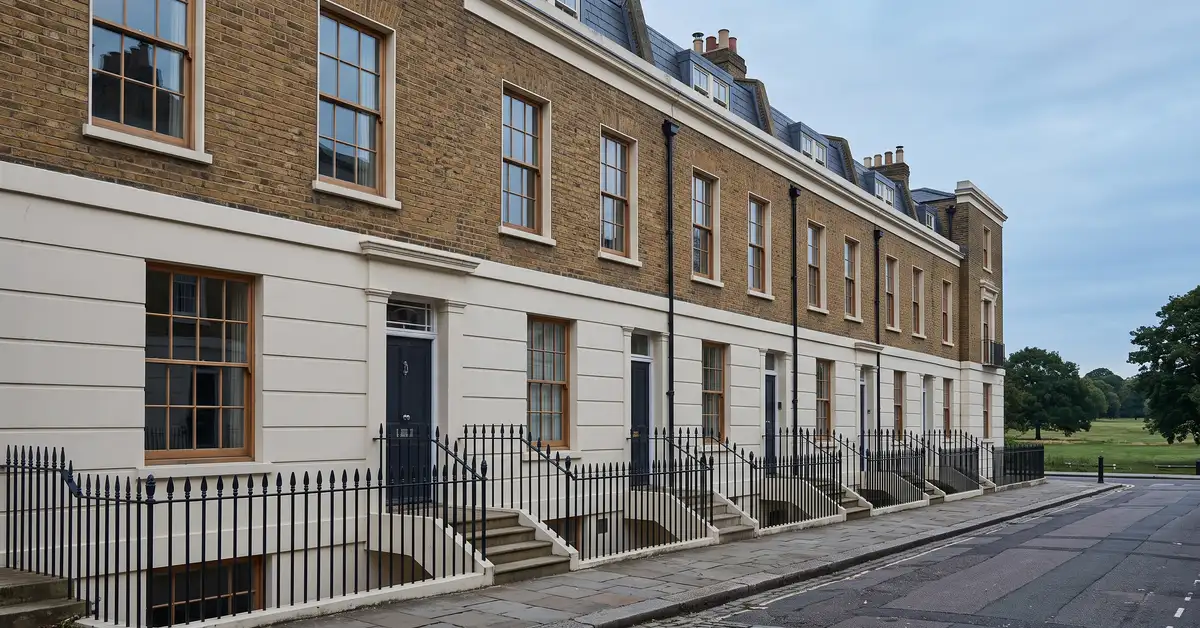
London and Kent Construction renovates Georgian, Victorian and Edwardian houses, garden flats and maisonettes across Greenwich and Blackheath, including listed buildings and homes in conservation areas. The work covers full refurbishment, extensions, loft conversions and structural alterations, run under one contract. Greenwich and Blackheath is the heart of the south east London patch where most of our work happens.
Renovating a period house here is a large commitment, and the published averages understate it. Checkatrade, in its cost guide updated in September 2026, puts a three-bedroom house renovation in the UK at £43,530 to £110,350. Most of the whole-property projects we carry out cost between £150,000 and £500,000, and some cost more, because the fabric is old, the planning position is layered and the streets are tight. Our renovation and refurbishment page sets out what is included and how a project runs.
The housing stock in Greenwich and Blackheath
Four kinds of building make up most of the period housing in Greenwich and Blackheath, and each brings a different set of problems once it is opened up. The Georgian terraces of West Greenwich, on Crooms Hill, Royal Hill and the streets between them, have solid walls with no cavity, lime plaster and original sash boxes. In our experience damp in these houses can be caused by a failed gutter or a cement render trapping moisture rather than anything rising, and repair comes before replacement. The Victorian terraces of the Ashburnham Triangle are two and three storeys, and many are now taking a side return or a rear extension; parapet gutters and valleys can be a source of water getting in. The larger villas around Blackheath Park and the Cator estate have more roof, more render and more window to maintain, and structural openings and basement work are common. The Edwardian bay-fronted houses of Westcombe Park and Vanbrugh Park have generous rooms and suit loft conversions, though in a conservation area the front roof slope often decides the design. Our guide to Victorian house renovation in London covers the fabric in more detail.

Conservation areas and Article 4 directions on the Greenwich side
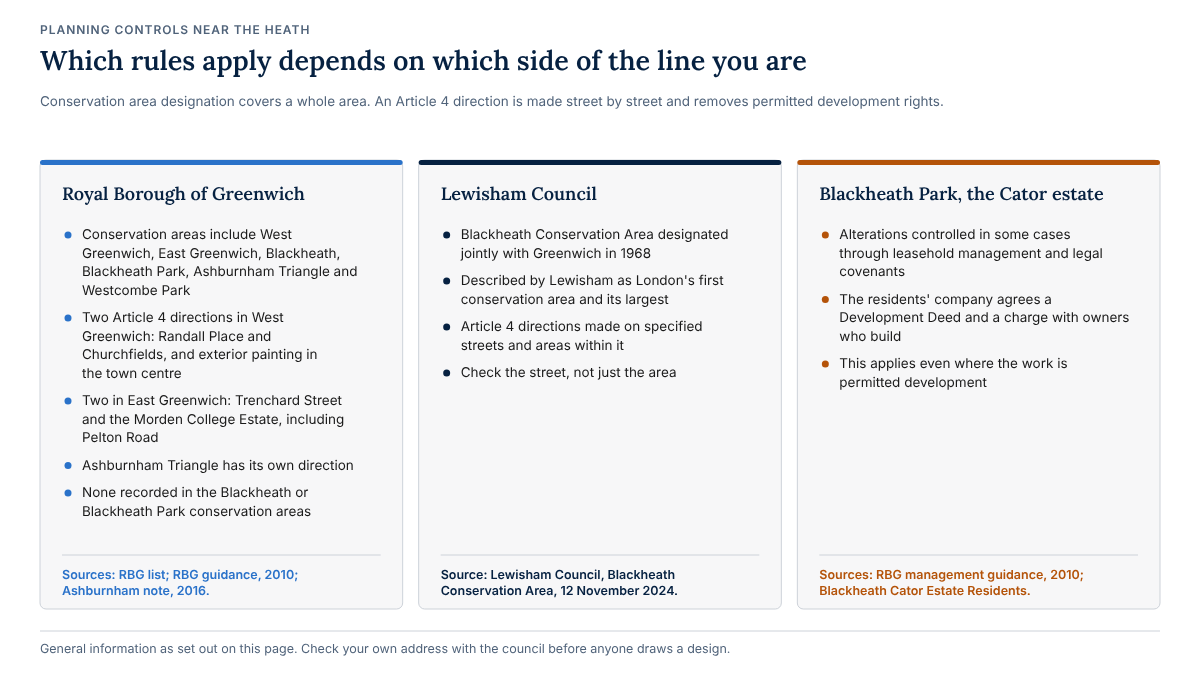
Conservation area designation and an Article 4 direction are two different things, and the difference decides whether ordinary work needs a planning application. Designation covers a whole area. An Article 4 direction is made street by street and withdraws permitted development rights that would otherwise apply. The Royal Borough of Greenwich's list of conservation areas includes West Greenwich, East Greenwich, Blackheath, Blackheath Park, the Ashburnham Triangle and Westcombe Park, and marks West Greenwich and East Greenwich as the areas where two Article 4 directions apply. The council's 2010 management guidance for the Greenwich and Blackheath conservation areas says one West Greenwich direction "removes permitted development rights to single dwellings in Randall Place and Churchfields" and the other controls exterior painting in the town centre, including Greenwich Church Street. In East Greenwich the directions "cover the houses in Trenchard Street and the greater part of the terraced streets on the Morden College Estate, including Pelton Road". The council describes the effect as bringing "single dwelling houses within planning control for minor works and external alterations". The Ashburnham Triangle has its own direction too: the council's 2016 guidance note lists extensions, windows and doors, roof and chimney alterations, porches, front and side boundary walls and exterior painting among the works that need permission.
Blackheath sits in two boroughs
Blackheath is split between two planning authorities, and the rules change at the boundary. On the Greenwich side, the council's 2010 guidance states plainly: “There are no Article 4 Directions in the Blackheath Conservation Area,” and says the same of Blackheath Park. On the Lewisham side, Lewisham Council describes Blackheath as “Designated jointly with Greenwich in 1968, this was London's first conservation area, and is Lewisham's largest”, and says it has “made Article 4 directions to specified streets and areas within the conservation area”. Two houses near the Heath can therefore sit under different councils and different controls. Blackheath Park adds a third layer. The Greenwich guidance notes that alterations there are “tightly controlled in a number of instances through leasehold management and legal covenants”, and Blackheath Cator Estate Residents says it agrees a Development Deed and a charge with owners who build, adding that “This also applies to developments which benefit from permitted development rights.” The first job on any Blackheath enquiry is to establish which council, and which estate, the address falls in.
Listed houses in Greenwich and Blackheath
Many of the Georgian houses here are listed, which adds a consent of its own. Historic England explains that “Listing status covers the entire building, so works requiring consent might include replacing windows and internal alterations, for example,” and that Grade II, the grade most homeowners will meet, covers around 91.7 per cent of listed buildings. Listed building consent sits alongside planning permission rather than replacing it. London and Kent Construction works on listed period houses; the practical consequences are a longer lead-in, a tighter specification and repair in matching materials. Our article on listed building renovation in London explains the consent route.
The work Greenwich and Blackheath homeowners most often ask for
The enquiries we get from Greenwich and Blackheath cluster into a short list. Full refurbishment after purchase, taking in rewiring, replumbing, replastering, heating, kitchens, bathrooms and repair of original joinery. Side return infills on Victorian terraces, widening a narrow kitchen to the full width of the house. Rear extensions, mostly single storey. Loft conversions, often a rear dormer, or a rooflight conversion where a dormer would be visible from the street. Structural alterations inside, typically removing a spine wall or chimney breast and putting in steel. Damp and roof repairs on solid walled houses sealed up with the wrong materials. Where an Article 4 direction applies or the house is listed, few of these are permitted development, and the order of work changes: design and consents first, then pricing, then a start date.
Fees and surveys before any building work starts
A Greenwich or Blackheath renovation carries a paperwork stage worth budgeting for separately. The HomeOwners Alliance puts a full structural survey at £500 to £1,500. The householder planning application fee in England is £548 from 1 April 2026, according to gov.uk, and fees are reviewed every year. Pre-application advice is charged by each council. The Royal Borough of Greenwich fee schedule, valid from 1 January 2026, charges homeowners £337 plus VAT for a duty planner meeting and £650 plus VAT for listed building advice. Lewisham Council, on a page published in April 2026, charges £252.93 including VAT for a householder virtual meeting on more complicated schemes, including work in a conservation area. On a terrace, add a party wall surveyor: the HomeOwners Alliance gives £1,200 to £1,500 for an extension with one surveyor appointed.

Building control and party walls on a terraced street
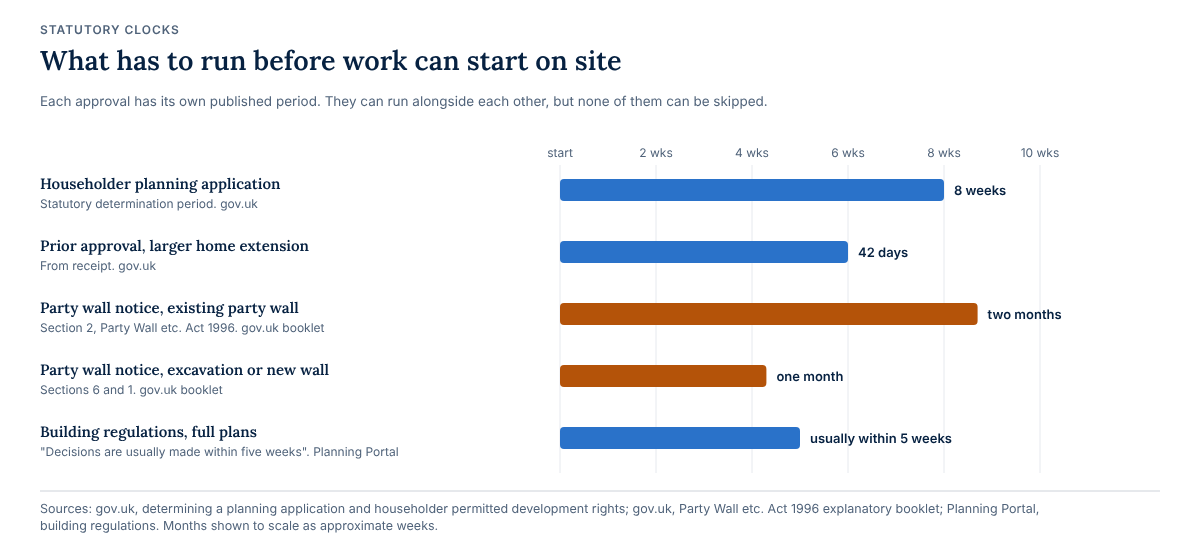
Building control is a separate approval from planning. Lewisham Council, on a page dated 28 October 2025, says approval is needed for “any alterations that are structural in nature”, and for major renovation where more than 25 per cent of a thermal element such as a roof, external wall or floor is affected. That threshold matters on period houses, where a re-roof or a replastered external wall can cross it. Party walls matter as much. Cutting into a shared wall for a steel beam, or digging foundations near a neighbour's house, brings in the Party Wall etc. Act 1996. The gov.uk explanatory booklet sets the notice periods: two months for work to an existing party wall, and one month for a new wall on the boundary or for excavating near a neighbour's building. Those periods run before work can start, so the notices belong at the start of the programme. On a terrace with no side access, everything also goes through the house, so we protect the route, seal the working area, record the condition of shared walls and introduce ourselves to the neighbours before the first day.
Taking over an unfinished project
Some enquiries start with a half-built extension and a builder who has stopped answering. London and Kent Construction has twice taken over unfinished projects in Notting Hill, one a substantially delayed renovation and one after the previous builder became insolvent. We assess and record what has been built, say plainly what can be kept, and price the rest properly. Our page on taking over a stalled site explains how that works.
Frequently asked questions
Do I need planning permission for a rear extension in a Greenwich conservation area?
It depends on the address and the design. Where an Article 4 direction applies to your street, permitted development rights for the work it covers are removed, so an application is needed. The Royal Borough of Greenwich lists which conservation areas have directions, so check before anyone draws a design.
Which council covers my house in Blackheath?
Blackheath is split between the Royal Borough of Greenwich and Lewisham Council, and the rules differ either side. Lewisham has Article 4 directions on specified streets, while Greenwich's guidance records none in its Blackheath and Blackheath Park conservation areas. Check your council tax bill or the councils' conservation area maps.
What does a renovation cost in Greenwich or Blackheath?
Most whole-property projects we carry out cost between £150,000 and £500,000, and some cost more. Single room work starts at around £10,000 to £15,000. Every job is priced from its own measured scope after a site visit, so a figure for your house comes after we have seen it.
Do you work on listed houses?
Yes. London and Kent Construction works on listed Georgian and Victorian houses. Listed building consent is needed for works affecting the building's character, including some internal work, so the consent stage is planned before the price is finalised.
What to do next
If you own a period house in Greenwich or Blackheath and want to know what your renovation involves, book a site visit. We will walk the house with you, look at the roof, the walls and the structure, tell you which council and which designations apply to the address, and set out how we would sequence and price the work. Book a site visit, call 020 8850 7064 or email team@londonandkent.co.uk.