

Before a London renovation starts you should have four things in writing: a contract that fits the size of the job, proof of the builder's insurance, a clear answer on who insures the works and your house during the build, and a statement of the guarantee you get afterwards. London and Kent Construction sets all four out before work begins. This guide explains what each one covers and what it does not.
The paperwork matters more on a large renovation because more can go wrong and more money is at stake. Citizens Advice, in research published on 7 July 2026, found that 28 per cent of people who hired a trader for work on their home in the previous 18 months experienced an issue. The Insolvency Service recorded 3,841 construction company insolvencies in England and Wales in the 12 months to July 2026, the most of any industry. Our guides on choosing a renovation builder and what to do if your builder goes bust cover the shortlist and the worst case. This article goes into the documents themselves.
A contract exists even if nothing is written down
Many homeowners assume there is no contract until something is signed. Citizens Advice puts it plainly: “When you tell the trader you'd like them to do the work, you've made a contract with them. This applies even if it's not written down.” The problem with an unwritten contract is proving what was agreed. On a renovation running to six figures, the scope, the price, the payment stages and the programme need to be written down before anyone starts, so that a disagreement in month four is settled by reading a document rather than by memory.
Which written contract fits a home renovation
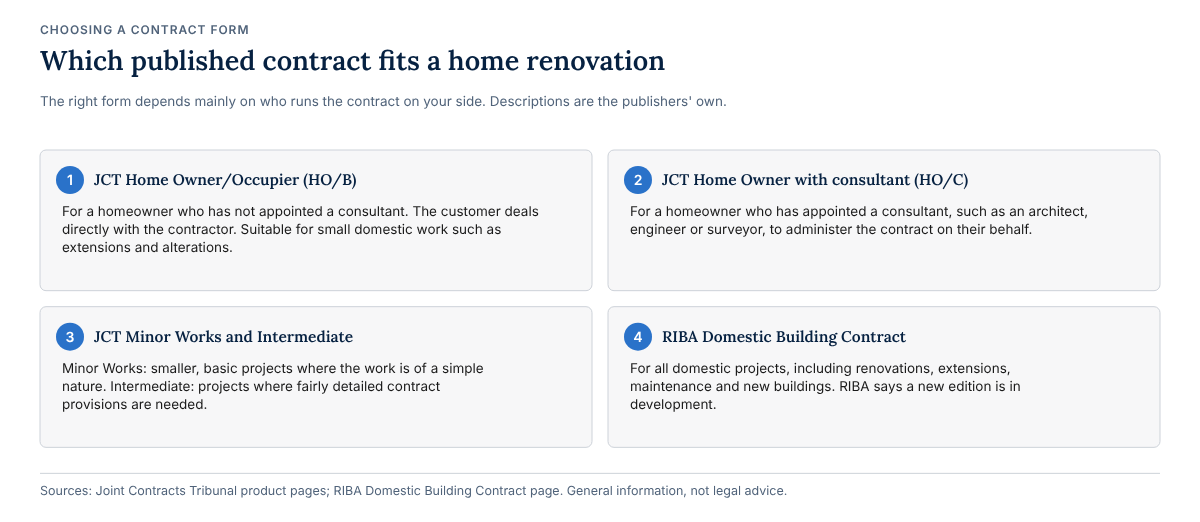
Several standard forms are published for building work on a home, and the right one depends on who runs the contract on your side. The Joint Contracts Tribunal's Building Contract for a Home Owner/Occupier (HO/B) is “for a home owner/occupier who has not appointed a consultant to administer the contract”, where “The customer deals directly with the contractor.” Its companion, the Building Contract and Consultancy Agreement (HO/C), is for a homeowner “who has appointed a consultant to administer the contract on their behalf”, such as an architect or surveyor. JCT also publishes the Minor Works contract, “designed for smaller, basic construction projects where the work is of a simple nature”, and the Intermediate contract, for projects “where fairly detailed contract provisions are needed”. The RIBA Domestic Building Contract “can be used on all domestic (non-commercial) projects, including renovations extensions, maintenance and new buildings”. If an architect is running your project, they will usually recommend the form.
What the contract needs to say
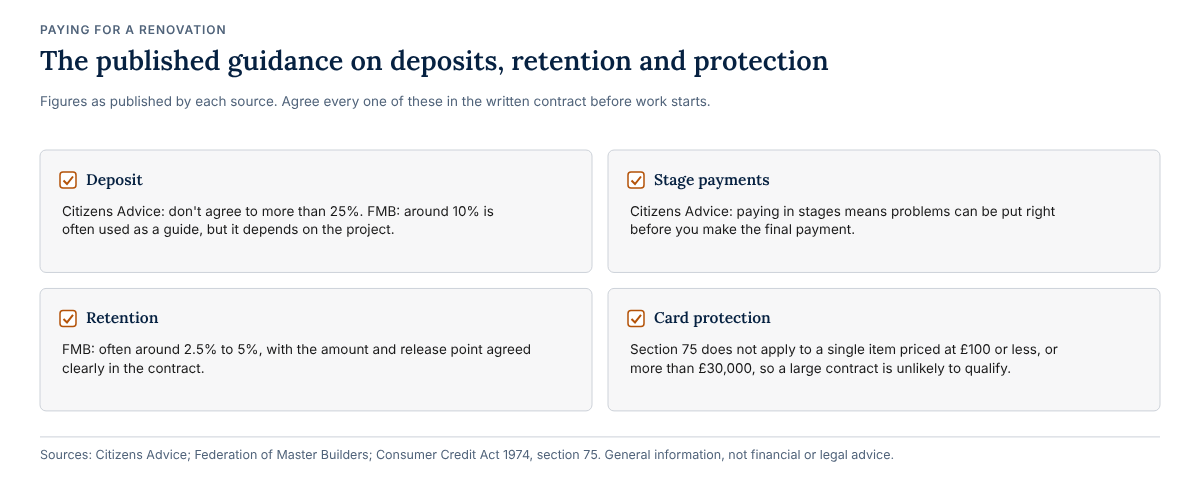
Whichever form is used, the content matters more than the cover page. The Federation of Master Builders, quoted here as independent guidance, lists what a contract should cover: who it is between, the agreed scope, the quote and specification, the drawings and consents, who is responsible for what, the price, how changes are priced and approved, start and completion dates, the payment schedule, insurance, warranties and guarantees, how defects and snagging are handled, what happens if work is delayed, and how disagreements are dealt with. Two of those deserve attention on a renovation. Changes, because opening up a period house nearly always finds something; the contract should say that extra work is priced and agreed in writing before it is done. And retention, the sum held back until defects are put right: the FMB says “Retention is often around 2.5%–5%, but the amount and release point should be agreed clearly in the contract.”
Your rights even where the contract is silent
Some protections apply to every consumer contract for a service, whatever the paperwork says. Under the Consumer Rights Act 2015, section 49, “the trader must perform the service with reasonable care and skill.” Section 52 adds that where no time is agreed, “the trader must perform the service within a reasonable time.” If the work falls short, section 54 gives “the right to require repeat performance” and “the right to a price reduction”, and section 55 says repeat performance must be done at the trader's own cost. Contracts agreed in your home rather than at the trader's premises can also carry a 14 day cancellation period under the Consumer Contracts Regulations 2013, though the regulations exclude some work that amounts to a substantially new building, so take advice on a very large scheme. This is general information, not legal advice.
The insurance your builder should hold
Ask to see the certificates rather than taking them on trust. gov.uk states that an employer must hold Employers' Liability insurance “to cover you for at least £5 million”, from an authorised insurer, as soon as they employ anyone. Citizens Advice lists the other policies to check: “Public liability insurance - to cover if someone's hurt or if property is damaged”; “Contractors' all-risk - to cover work that's damaged or destroyed before it's completed”; and “Professional indemnity insurance - to cover if a trader does faulty design work or gives bad advice”, which matters on design and build. Contractors' all-risk is easy to overlook. If a fire or a storm damages a half-built extension, it decides whose insurer pays to rebuild it. Check the names, the limits and the expiry dates, and ask for renewals if the job will run past them.

Your own buildings insurance during the work
Your home insurance is the other half of the cover, and it is easy to forget. Citizens Advice says: “Contact your buildings insurance company to check you'll be covered during the work,” and warns that you may pay more during and after the work. The HomeOwners Alliance is blunter: “If you don't let your insurer know and there's a problem with the property at some point, you may find your policy is void.” Many whole-house renovations are done with the house empty, which can matter to an insurer too, so mention it. Citizens Advice adds that “Your home insurance will cover the work once it's completed,” which is another reason to tell your insurer what has been built and what it is worth.
Guarantees and warranties after handover
A guarantee is only as good as the business or insurer behind it, so ask what yours is and how long it lasts. Many builders offer a defects period after handover, during which they return to put things right; at London and Kent Construction it is normally twelve months. TrustMark says its registered businesses “are expected to provide a minimum two-year guarantee.” An insurance-backed guarantee goes further: the Federation of Master Builders, which sells one, says it “covers the cost of any issues with your building work for up to a decade after the building work finishes.” Citizens Advice suggests you “Check if the guarantee is personal to you, or if it can be passed to future owners if you sell your home.” Do not assume a new-build warranty applies: NHBC describes Buildmark as “our 10-year warranty and insurance cover for new-build or newly-converted homes.” Finally, keep the building control completion certificate. gov.uk says you will usually get it “within 8 weeks of completion of the building work, as long as it complies,” and that without approval “you will not have the certificates of compliance you may need when you want to sell your home.”

What CHAS, Constructionline and NHBC tell you about a builder
Accreditation logos are worth checking, but each scheme checks something different. CHAS describes itself as “The UK's trusted standard for contractor compliance and risk management”, and its core assessment covers health and safety, including the Safety Schemes in Procurement standard. Constructionline runs pre-qualification for buyers of construction work, “validating all members against PAS91 criteria and beyond”. NHBC registration is about new homes: a registered builder can “build and sell homes with the benefit of Buildmark warranty and insurance”, and anyone registered “will need to comply with the NHBC Rules”. None of them is a guarantee of a particular renovation, and none replaces the contract, the insurance certificates and the references. London and Kent Construction is a member of CHAS and Constructionline and is registered with NHBC. It is not a member of the Federation of Master Builders, which is quoted in this article as independent guidance only.

Paying in a way that protects you
How you pay is part of the protection. Citizens Advice says “Paying in stages is a good idea, because it means problems can be put right before you make the final payment,” and advises not to agree a deposit of more than 25 per cent; the FMB says “Around 10% is often used as a guide, but the right amount will depend on the project.” Card protection has limits on a project this size. Under section 75 of the Consumer Credit Act 1974, the card provider's liability does not apply to a single item with a cash price of £100 or less, or of more than £30,000, so a whole-house contract above that figure is unlikely to qualify. Take advice before relying on it. Our guide to choosing a builder covers payment schedules in more detail.
If something goes wrong
Many disputes are settled by going back to the contract, which is why the drafting matters. Where they are not, the formal routes have limits. In England, under Civil Procedure Rule 26, “the small claims track is the normal track for any claim which has a value of not more than £10,000,” so a large renovation dispute will usually sit above it. Trade scheme complaint routes are narrower than people expect: TrustMark's dispute resolution ombudsman does not consider “commercial disputes (such as financial or contractual) or claims for compensation”. A contract that names a dispute process, such as adjudication or mediation, gives both sides a route before anyone reaches for a solicitor.
How London and Kent Construction sets this out
At London and Kent Construction the quotation is priced element by element from a measured scope, with exclusions stated as clearly as inclusions, and it sits alongside a written contract, a programme and a start date. The contract is a JCT form suited to the job, such as the Home Owner contract or Minor Works, with JCT’s forms for larger works on bigger projects. Anything outside the agreed scope is priced in writing and instructed before the work is done. The deposit and the payment stages are agreed at contract stage. At handover we walk the house with you, agree a snagging list, put it right and hand over every certificate the works generate, followed by a defects period of normally twelve months. We also offer an insurance-backed guarantee. Our renovation and refurbishment page sets out the whole process.
Frequently asked questions
Which JCT contract should I use for a house renovation?
If you are dealing with the builder directly, JCT's Building Contract for a Home Owner/Occupier (HO/B) is written for that. If an architect or surveyor will run the contract for you, the consultancy version (HO/C) or a form your architect recommends is usual.
What insurance should a builder have?
Employers' liability, which gov.uk says must cover at least £5 million if they employ anyone, plus public liability and contractors' all-risk. Professional indemnity matters if they are designing the work. Ask to see the certificates and check the dates.
Does NHBC cover my renovation?
NHBC describes its Buildmark warranty as cover for new-build or newly converted homes. On a renovation of an existing house, ask the builder what guarantee applies, how long it lasts and whether it is insurance-backed or transferable.
Do I need to tell my home insurer about building work?
Yes. Citizens Advice says to contact your buildings insurer to check you are covered during the work, and the HomeOwners Alliance warns that a policy may be void if you do not. Mention if the house will be empty.
What to do next
If you are planning a renovation and want to see how we would set out the scope, the contract and the programme for your house, book a site visit. We will walk the property with you, say what we think the real issues are and explain how we would price and run the work. Book a site visit, call 020 8850 7064 or email team@londonandkent.co.uk.