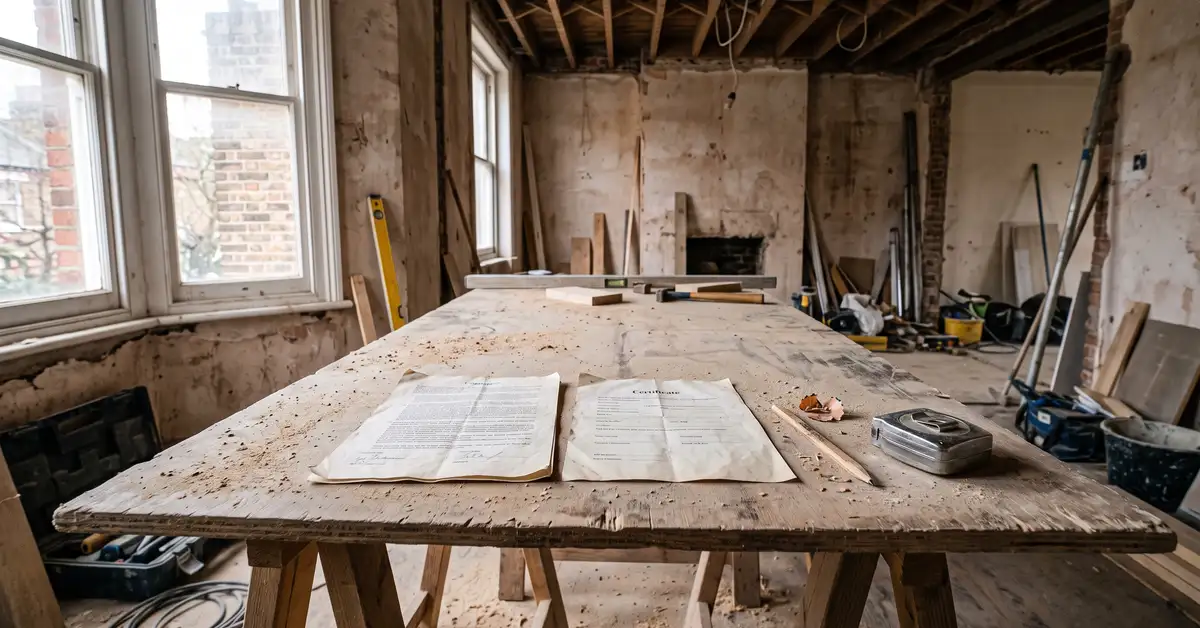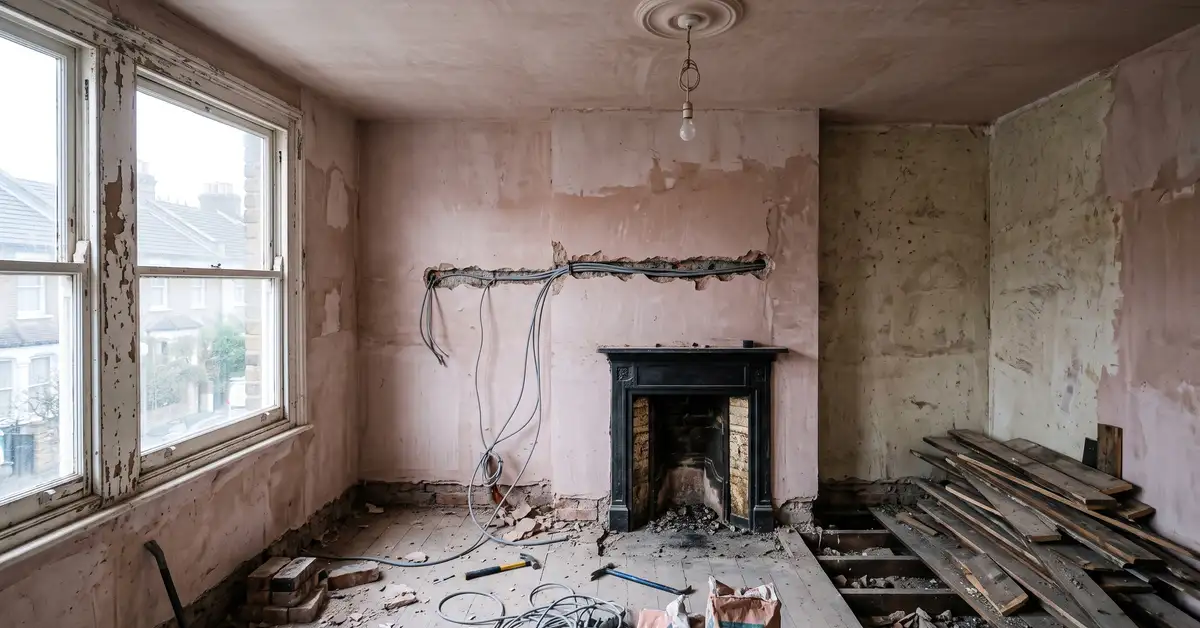

A party wall agreement is the written consent, or the surveyor's award, that the Party Wall etc. Act 1996 requires before you cut into, underpin or dig near a wall you share with a neighbour. London and Kent Construction advises clients to serve notice early, because the notice period runs before any of that work can start.
The rules come from the Party Wall etc. Act 1996, and the government's explanatory booklet on the Act sets out how they work in practice. Notice must be given at least two months before work to an existing party wall and at least one month before a new wall on the boundary or an excavation near a neighbour's foundations. On a terraced London house, almost every extension, loft conversion and basement touches at least one of those.

The work on a London house that needs a party wall notice
The Party Wall etc. Act 1996 covers three kinds of work: work to an existing party wall or party structure, a new wall built at or astride the boundary and excavation close to a neighbour's building. A party wall is a wall that stands astride the boundary between two owners' land, such as the wall between two terraced houses. The gov.uk explanatory booklet lists the common examples, and several of them describe ordinary renovation work on a period terrace:
- cutting into a party wall to take the bearing of a beam, for example for a loft conversion
- raising the height of a party wall, for example to add another storey
- underpinning the whole thickness of a party wall, for example to form a basement
- inserting a damp proof course
- cutting off projections from a party wall, for example removing a chimney breast
- demolishing and rebuilding a party wall that is structurally defective
The booklet is clear that the Act applies even to work on your own side: "You must not even cut into your own side of the wall without telling the Adjoining Owners of your intentions". The Act applies throughout England and Wales and has been in force since 1 July 1997.
Party wall notice periods and how long a notice lasts
Party wall notice periods are fixed by the Act, and the work cannot start until the period has run unless the neighbour agrees in writing to an earlier start. The explanatory booklet gives the periods as:
- Work to an existing party wall or structure (section 2): two months
- A new wall on the boundary line (section 1): one month
- Excavation near a neighbour's building (section 6): one month
A party wall notice does not last for ever. The booklet says, for each type of notice, that "The notice is only valid for a year, so do not serve it too long before you wish to start." In practice that means serving notice once the design is settled enough to describe the work, but not so early that a delayed start lets the notice lapse. Notices can be delivered in person, by post or by email where the neighbour has agreed to receive them that way.
The 3 metre and 6 metre rule for excavation
The excavation part of the Party Wall etc. Act 1996 catches more London projects than most homeowners expect, because it applies to digging on your own land near a neighbour's building, not only to work on the shared wall. According to the gov.uk explanatory booklet, notice is needed where you excavate, or excavate and build foundations:
- within 3 metres of any part of a neighbour's building or structure, where any part of the work will go deeper than the neighbour's foundations, or
- within 6 metres of any part of a neighbour's building or structure, where the work will cut a line drawn downwards at 45 degrees from the bottom of the neighbour's foundations
Foundations for a rear or side return extension on a Victorian terrace are often within 3 metres of the house next door and often deeper than its shallow footings, so the excavation rule commonly applies even where no party wall is touched. Under the same section, the neighbour may require you to underpin, strengthen or safeguard the foundations of their building so far as the work makes that necessary.

What happens after the party wall notice is served
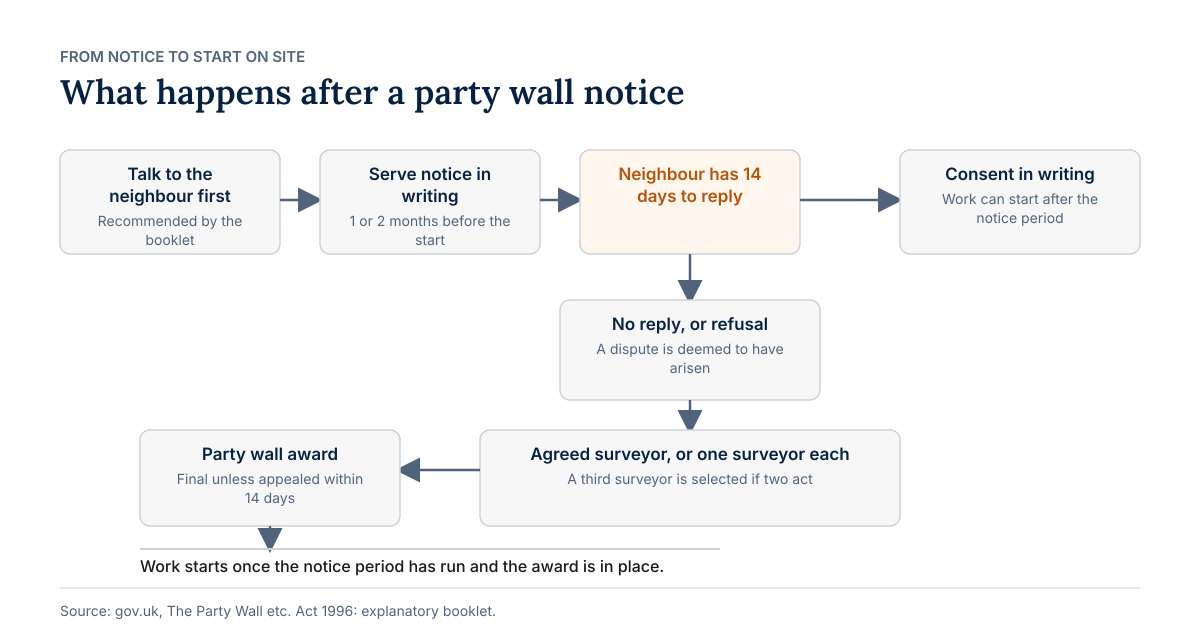
A neighbour who receives a party wall notice has 14 days to respond in writing. The neighbour can consent, or refuse and ask for the matter to be settled by surveyors. If the neighbour does nothing at all, the explanatory booklet is plain about the result: "If, after a period of 14 days from the service of your notice, the person receiving the notice has done nothing, a dispute is deemed to have arisen."
A "dispute" under the Act is a procedural term, not a falling out. It simply means the work goes ahead under a surveyor's award rather than on a neighbour's written consent. A neighbour can also give a counter notice within one month, asking for extra work to be done for their own benefit, and the building owner then has 14 days to respond to that.
Consent does not end your obligations. The booklet notes that where consent is given, you still have to avoid unnecessary inconvenience and provide temporary protection for neighbouring buildings where needed. If damage is caused later, the dispute procedure can still be used.
Party wall surveyors and the party wall award
Where there is a dispute, the Party Wall etc. Act 1996 settles it through surveyors, who produce a document called a party wall award. The award sets out the work, how and when it is to be done, and allows the surveyors access to check the work while it is going on. There are two ways to appoint surveyors, as the explanatory booklet describes:
- An agreed surveyor. Both owners agree on one surveyor, who draws up the award alone.
- Two surveyors. Each owner appoints their own surveyor, the two prepare the award together and they select a third surveyor who is called in only if they cannot agree.
Whichever route is used, the surveyors must act impartially. The booklet says surveyors appointed under the Act "must consider the interests and rights of both owners and draw up an award impartially". The award is final and binding unless a county court changes it on appeal, and each owner has 14 days from being served with it to appeal. It is worth keeping the award with the property deeds.
How much a party wall agreement costs in London
The cost of a party wall agreement is mostly surveyors' fees, and the building owner usually pays all of them, including the neighbour's surveyor. The explanatory booklet says the building owner will usually pay "all costs associated with drawing up the award including the adjoining owner's surveyor's fees, if the works are solely for the Building Owner's benefit." The surveyors decide who pays, and an owner who thinks a fee is unreasonable can ask for a breakdown.
The HomeOwners Alliance (page last updated 10 March 2026) gives an average party wall surveyor cost of £900 to £2,700 for most standard projects, around £1,000 for a party wall agreement when one surveyor is appointed, and hourly rates of £90 to £450. It says costs may double if two surveyors are appointed. Its figures by type of project are:
- Loft conversion: £900 to £1,200 with one agreed surveyor, £1,800 to £2,400 with two surveyors
- Extension: £1,200 to £1,500 with one agreed surveyor, £2,400 to £3,000 with two surveyors
- Basement: £1,800 to £2,700 with one agreed surveyor, £3,600 to £5,400 with two surveyors
These are averages for one neighbour. A mid terrace house usually has two adjoining owners and a basement or a deep extension may involve more, so the figure for a London project can be a multiple of these figures. They are national figures, not a price for your project.

Security for expenses, access and what the Act does not do
The Party Wall etc. Act 1996 gives the neighbour some protection beyond the award. Before work starts, a neighbour can ask for security for expenses: money, a bond or insurance that can be drawn on if the building owner stops at an awkward stage and leaves the neighbour's property exposed. The explanatory booklet explains that the money remains the building owner's throughout. The Act also gives a right of access to the neighbour's property where it is needed for the notified work, on 14 days' notice except in an emergency.
The Act sits alongside planning and building regulations, not in place of them. The booklet says that party wall agreement "does not remove the possible need to apply for planning permission and/or to comply with building regulations procedures", and that planning permission or building regulations approval does not remove the need to follow the Act either. The Act also cannot settle where a boundary lies. Starting work without notice is a civil matter, and a neighbour can seek a court injunction to stop the work.
Fitting the party wall process into a renovation programme
The party wall process is easiest when it runs alongside design and planning rather than after them. The booklet recommends talking to neighbours before notice is served, so that the notice does not come as a surprise. A neighbour who has seen the drawings is more likely to consent within the 14 days, and consent avoids surveyors' fees altogether.
Three points make the biggest difference on a London house. Serve notice on every adjoining owner, which on a terrace usually means both sides and sometimes the owner behind. Remember that flats in a converted house can mean several owners for one wall, including freeholders and leaseholders with more than a year to run. And allow for the one month or two months before the date you want to start, plus time for surveyors to agree an award if there is a dispute. Our guide to how long a house renovation takes in London shows how party wall notices fit around planning and the wait for a builder. London and Kent Construction recommends party wall surveyors to its clients.
Frequently asked questions
Do I need a party wall agreement for a loft conversion?
Usually, yes. Cutting into a party wall to take the bearing of a beam is one of the examples in the gov.uk explanatory booklet, and it needs at least two months' notice to each adjoining owner. A neighbour's written consent is enough if they give it.
What happens if my neighbour ignores the party wall notice?
A dispute is deemed to have arisen after 14 days. If the neighbour also fails to appoint a surveyor, you can appoint one on their behalf under the Act, so that the surveyors can draw up an award without the neighbour's cooperation.
Who pays for the neighbour's party wall surveyor?
Usually the building owner, where the work is solely for their benefit. The surveyors decide who pays for the award and for checking the work. Costs can be shared where work is needed because of a defect or need of repair.
How long is a party wall notice valid?
One year. The gov.uk explanatory booklet says each notice is only valid for a year, so it should not be served too long before you intend to start work.
Does planning permission cover party wall matters?
No. The Party Wall etc. Act 1996 is separate from planning and building regulations. Having planning permission or building regulations approval does not remove the need to serve notice, and a party wall agreement does not replace either approval.
Talk to us before you serve notice
If you are planning an extension, a loft conversion or a basement on a London terrace, the party wall timetable is part of the programme from the start. London and Kent Construction carries out renovation and refurbishment on Victorian, Edwardian and Georgian houses across South East, South West and West London. Our guides to loft conversions in London and side return extensions on Victorian terraces cover the work that most often needs notice. Book a site visit through our contact page, on 020 8850 7064 or at team@londonandkent.co.uk.